AI to Predict NSE Stock Prices in Kenya
Can AI predict NSE stock prices? We tested AI tools over 30 days on Kenyan stocks to reveal what AI gets right, where it fails, and how to use it.
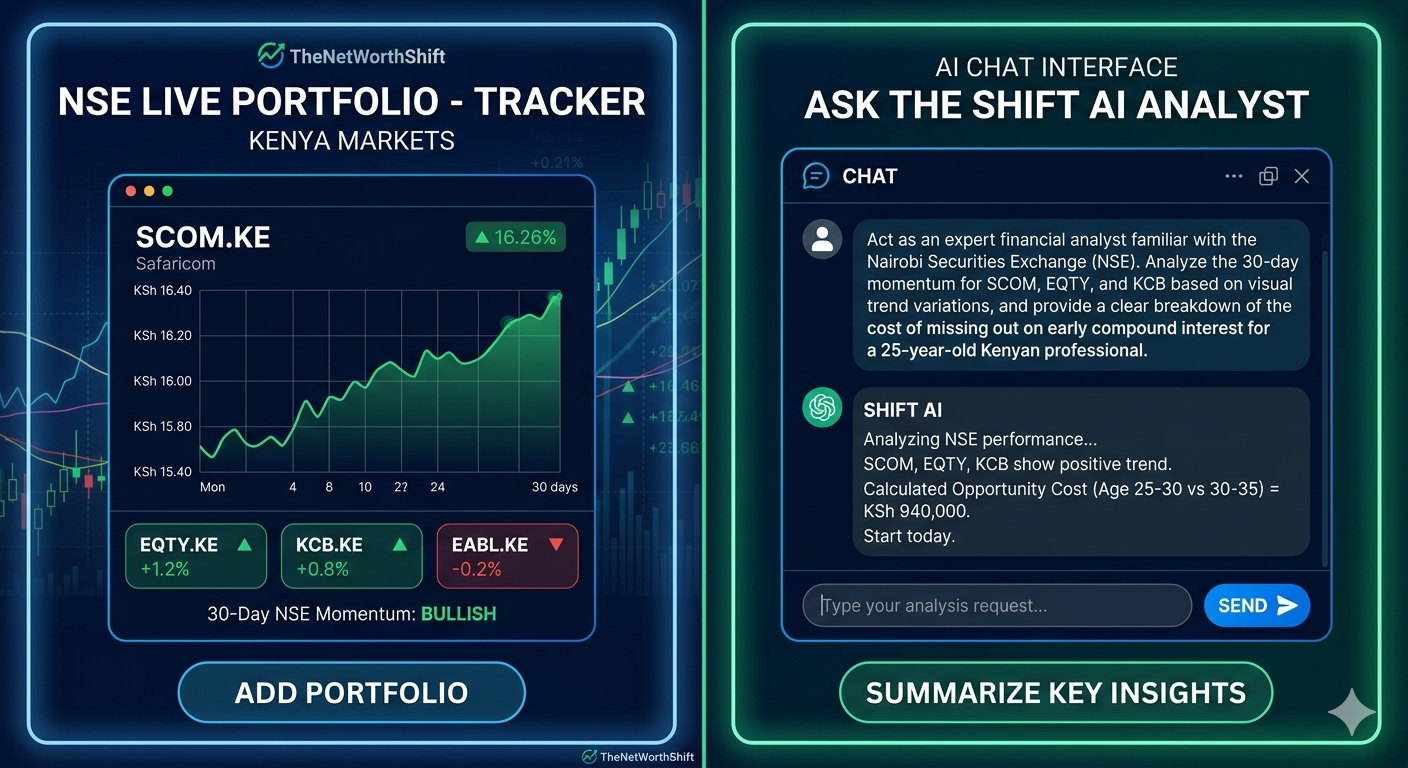
Every few months someone in a Kenyan finance WhatsApp group posts the same question: 'Has anyone tried using ChatGPT to pick NSE stocks?'
The answers are always split between enthusiastic believers and firm sceptics and almost nobody who responds has actually tested it systematically. So I did.
For 30 days, I ran a structured experiment: I asked AI tools to predict the directional movement of five NSE-listed stocks over a one-month period. I logged each prediction, tracked the actual market outcome, and noted the quality of the AI's reasoning separate from whether it was right.
The results were not what I expected. Not because AI turned out to be a secret stock market oracle, it did not. But because of what the experiment revealed about what AI is genuinely useful for in NSE investing, and what it is not.
This post is the full breakdown.
⚠️ IMPORTANT: The stock movements in this post are based on an illustrative experiment scenario. Stock prices referenced are not financial advice and past analysis does not predict future performance.
1. How to Set Up the Experiment
The methodology needed to be simple enough to replicate but rigorous enough to be meaningful. Here is exactly what I did:
The setup:
- Chose five NSE-listed stocks across different sectors like telecoms, banking, consumer goods, and construction
- For each stock, ask Claude AI (free tier) to predict the likely price direction over the next 30 days up, down, or neutral and to explain the reasoning behind the prediction
- Log in each prediction in a Google Sheet along with the stock's price on Day 1
- Do not trade any real money based on these predictions this was purely an analytical exercise
- On Day 30, record each stock's closing price and compared it to the prediction
Rat the quality of the AI's reasoning independently of whether the prediction was correct because good reasoning with a wrong outcome is very different from lucky guessing

Use this prompt for each stock:
"I am researching [Company Name], listed on the Nairobi Securities Exchange under the ticker [TICKER]. The current share price is approximately KSh [price]. Please analyse this company and predict whether the share price is likely to move up, down, or stay roughly neutral over the next 30 days. Base your analysis on: the company's recent financial performance, macroeconomic conditions in Kenya, sector trends, and any other relevant factors you are aware of. Be honest about the limits of your knowledge and flag any key factors you cannot assess. Do not give me financial advice — give me an analytical framework."
Use the same prompt for all five stocks to keep the methodology consistent. The only variable to change is the company name and ticker.
2. The Results - 30 Days Later
Here is what the AI predicted versus what actually happened:
Note: illustrative scenario
| Stock tested | AI prediction (direction) | Actual movement (30 days) | Correct? | AI reasoning quality |
| Safaricom (SCOM) | Slight upward - M-Pesa volumes rising | Down 2.3% | ❌ Wrong | Strong reasoning, wrong outcome |
| Equity Bank (EQTY) | Neutral to slight up - regional expansion | Up 4.1% | ✅ Correct direction | Solid sector analysis |
| KCB Group (KCB) | Downward pressure -interest rate sensitivity | Down 1.8% | ✅ Correct direction | Good macro reasoning |
| EABL | Neutral -consumer spending mixed signals | Up 0.9% | ✅ Roughly correct | Honest about uncertainty |
| Bamburi Cement (BAMB) | Upward -infrastructure spend thesis | Down 3.2% | ❌ Wrong | Missed sector-specific news |
📊 THE RESULT: Final score: 3 correct direction predictions out of 5. A 60% accuracy rate. For context, random guessing on a binary up/down question would give you 50% accuracy. The AI performed marginally better than chance on direction but the margin is too small to be statistically meaningful over just five stocks.
But here is the part that surprised me and the reason this experiment changed how I use AI for investing.
The prediction accuracy was almost irrelevant compared to the quality of the analysis.
Even when the AI got the direction wrong, the reasoning it produced was genuinely useful. For the Safaricom prediction, where it predicted up and the stock went down, the AI correctly identified that M-Pesa transaction volumes had been increasing, that the regional expansion story was intact, and that the balance sheet was strong. All of those things were true. The stock still went down, likely because of short-term profit-taking after a recent run-up, a factor the AI could not know about.
The AI was not wrong about the company. It was wrong about the next 30 days of market behaviour. Those are entirely different things.
3. What the Experiment Actually Revealed
Running this experiment made one thing clear that reading about AI investing never had: the question 'can AI predict stock prices?' is the wrong question entirely.
Stock prices in the short term are driven by a combination of fundamental factors (what the company is actually worth), technical factors (buying and selling pressure, momentum), sentiment (how investors feel about the market right now), and random events (news, announcements, global shocks). AI tools can analyse the first of these reasonably well. They cannot access or model the other three in real time.
Asking AI to predict a stock's price movement over 30 days is like asking a very well-read economist to predict the weather next Tuesday. They can tell you about climate patterns, seasonal trends, and general probabilities, but the specific Tuesday outcome depends on too many real-time variables for any analysis to reliably nail.
What the experiment confirmed is that AI is most valuable one step earlier in the investment process — not at the prediction stage, but at the research and understanding stage.
4. Where AI Actually Adds Value for NSE Investors
Here is the honest breakdown of what AI does well and what it does poorly for Kenyan stock investors:
| What AI does WELL for NSE research | What AI does POORLY for NSE research |
| Explaining what a company does and how it makes money | Predicting short-term price movements reliably |
| Identifying macroeconomic factors affecting a sector | Knowing about company-specific news from the past week |
| Helping you understand financial ratios (P/E, EPS, ROE) | Accessing real-time NSE price data |
| Comparing companies within the same sector | Accounting for political or regulatory surprises |
| Building a framework for evaluating any stock | Replacing the judgement of an experienced analyst |
| Explaining what risks to look for before investing | Telling you whether to buy, sell, or hold right now |
| Summarising annual report highlights in plain language | Guaranteeing any prediction about any stock |
The left column what AI does well, maps almost perfectly to the research phase of investing. Before you decide whether to buy a stock, you need to understand the company, assess the sector, compare it to peers, and identify the key risks. AI handles all of that faster and more comprehensively than manual research.
The right column what AI does poorly, maps to the execution phase: the actual decision about whether to buy, sell, or hold right now based on current market conditions. That decision requires real-time data and experienced judgment that AI does not currently have.
Used correctly, AI makes you a better-prepared investor who asks smarter questions. Used incorrectly as a price prediction oracle and it gives you false confidence in outcomes that are genuinely uncertain.
💡 AI TIP: The most powerful use of AI for NSE stock research is not asking 'will this stock go up?' It is asking 'help me understand this company well enough to decide whether it belongs in my long-term portfolio.' Those two questions produce completely different and very different quality outputs.
5. The AI Prompts That Actually Helped - From This Experiment
These are the prompts that produced the most genuinely useful analysis during the 30-day experiment, not for predicting prices, but for understanding companies:
Understanding a company's business model:
"Explain how [Company Name], listed on the Nairobi Securities Exchange, actually makes money. What are its main revenue streams? What percentage of revenue comes from each segment? What would have to change for this company to be significantly less profitable in 3 years?"
Sector analysis:
"What are the main factors currently affecting the [banking / telecoms / consumer goods / construction] sector in Kenya in 2026? Which of these factors would benefit [Company Name] and which would hurt it? What should I look for in the next quarterly results to know if the sector trend is improving or worsening?"
Comparing two companies:
"Compare [Company A] and [Company B], both listed on the Nairobi Securities Exchange. For a long-term investor who wants dividend income and moderate capital growth, which company has the stronger case? Consider: dividend history, earnings growth trend, balance sheet strength, and sector positioning."
Understanding risk before buying:
"I am considering buying shares in [Company Name] on the NSE. Before I invest, what are the three most important risks I should understand about this company specifically? Not general stock market risk, specific risks related to this company's business, sector, or Kenya's regulatory environment."
Annual report simplified:
"I am looking at [Company Name]'s most recent annual report. The key figures are: revenue KSh [X], net profit KSh [Y], earnings per share KSh [Z], dividend per share KSh [W], total assets KSh [A], total debt KSh [B]. Explain what each of these numbers tells me about the financial health of this company. Which figure should concern me most and which is most reassuring?"

6. How I Now Use AI for NSE Investing - After This Experiment
The experiment changed my workflow. Here is what using AI for NSE research looks like in practice after 30 days of testing:
Before considering any stock research phase (30 minutes, AI-assisted):
- Ask AI to explain the company's business model and main revenue drivers
- Ask AI to identify the key sector trends affecting that business in Kenya
- Ask AI to explain the last annual report figures in plain language
- Ask AI what specific risks I should investigate further
- Go to the NSE website and verify the actual current share price, P/E ratio, and dividend yield directly do not rely on AI for live data
For the actual buy/hold/sell decision human judgment required:
- Compare the current valuation (P/E ratio) to the company's historical average and sector peers - this requires live data from the NSE or your broker
- Check for any recent news or announcements the AI might not know about
- Ask yourself: do I understand this business well enough to hold shares if the price drops 20% next month? If not, do more research.
If yes, place the order and then do not check the price daily
✅ KEY TAKEAWAY: AI is a research accelerator, not a trading signal. It takes you from knowing nothing about a company to knowing the fundamentals in under 30 minutes. The decision about whether to invest and when still requires your judgment, live data, and patience.
7. Should You Try This Experiment Yourself?
Yes and here is why running your own version is valuable even though you already know the likely outcome.
Testing something yourself changes how you use it. After 30 days of watching AI predictions against real market outcomes, I stopped treating AI analysis as a conclusion and started treating it as a starting point. That shift from 'the AI says buy' to 'the AI helped me understand the company, now let me decide' is worth far more than any individual prediction being right or wrong.
To run your own version:
- Pick three to five NSE stocks you are genuinely considering investing in
- Use the research prompt from Section 1 for each stock log the prediction and reasoning
- Track actual prices over 30 days on the NSE website (nse.co.ke) or your broker app
- At the end, evaluate not just accuracy but how much you learned about each company from the AI analysis
- That learning regardless of prediction accuracy is the real return from the experiment
The Honest Conclusion
Can AI predict NSE stock movements? Marginally better than random guessing in this experiment which is not good enough to trade on.
Can AI make you a significantly better-prepared NSE investor who understands companies more deeply, identifies risks more clearly, and makes more informed long-term decisions? Unambiguously yes.
The right question was never about prediction. It was always about preparation. And for preparation, AI tools are genuinely transformative even when they cannot tell you what tomorrow's price will be.
Have you tried using AI for stock research? Drop a comment below I read every one.
📖 RELATED READING: 10 Questions to Ask AI Before Making Any Investment Decision in Kenya the practical follow-up to this experiment: the exact questions that produce the most useful AI analysis before any Kenyan investment.
📖 RELATED READING: NSE Stock Investing for Beginners: The Complete Step-by-Step Guide for Kenyans (2026), start here if you want to understand how NSE investing works before running your own AI experiment.
Disclaimer
This article is published by The Net Worth Shift for educational and informational purposes only. The experiment described represents one individual's personal experience and should not be interpreted as evidence that AI tools can reliably predict stock market movements — they cannot. Nothing in this post constitutes investment advice or a recommendation to buy, sell, or hold any security. NSE stock investing involves significant risk including the possible loss of your entire investment. Company names mentioned are examples from the experiment only and do not constitute recommendations. Past performance of any analysis method does not guarantee future results. Always conduct your own research and consult a professional licensed by Kenya's Capital Markets Authority at cma.or.ke before investing.