From Zero to KSh 1 Million: The AI-Powered Portfolio Strategy That Changed My Financial Story at 32
How to build wealth in Kenya using AI: a 5-year strategy on a Nairobi salary to reach KSh 1M in MMFs, T-bills, and stocks. Exact year-by-year plan.
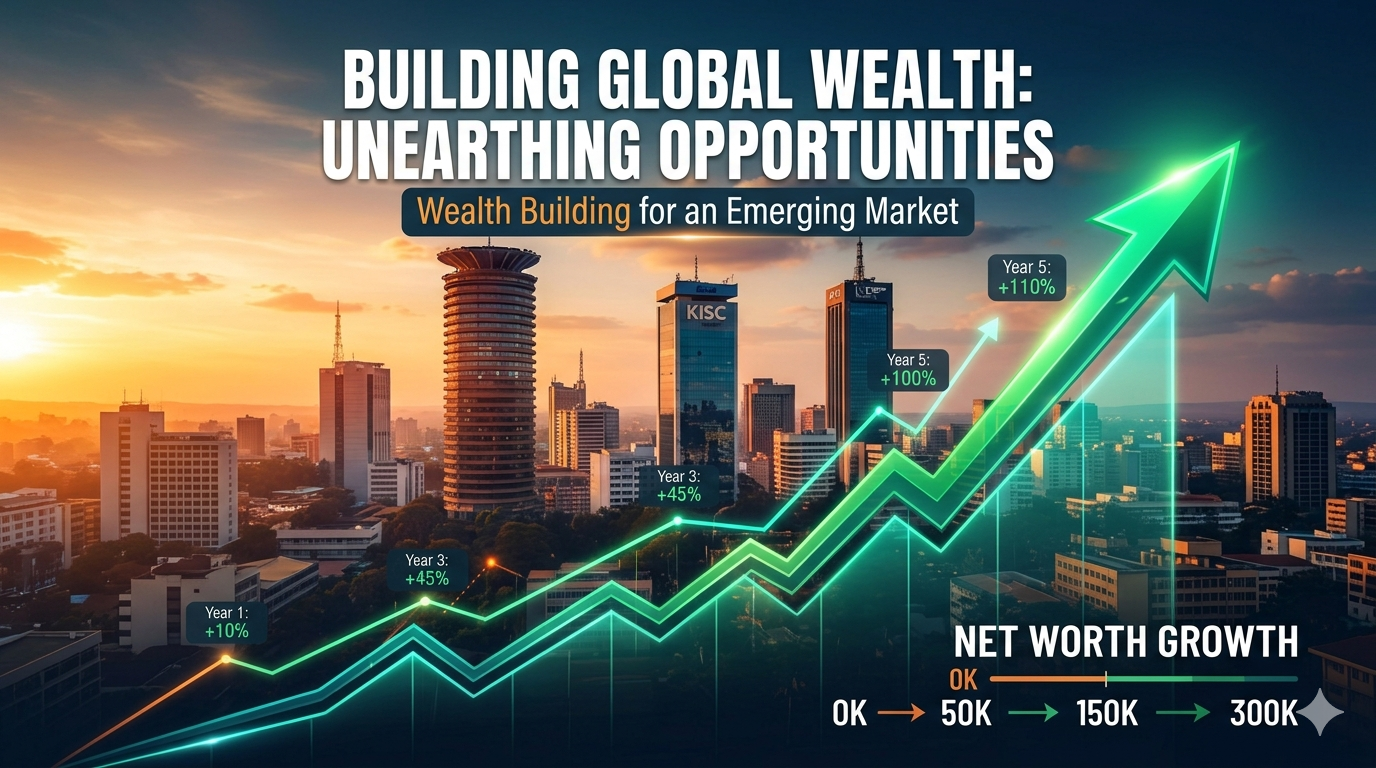
Disclosure: The financial journey described in this post uses realistic illustrative figures based on a plausible Nairobi professional's experience. Individual results vary significantly based on income, expenses, market conditions, and investment choices. This is not a guaranteed outcome it is an example of what consistent, informed investing can achieve. Not financial advice.
At 28, my entire financial portfolio consisted of KSh 12,000 in a savings account earning 4%, a Fuliza limit I used more than I should admit, and a vague plan to 'start investing properly' when my salary got a little better.
My salary was KSh 58,000 per month. It was not the problem.
Four years later, at 32, I crossed KSh 1 million in invested assets for the first time. Money market funds. Treasury bills. A small but growing NSE stock portfolio. A SACCO I had been building for two years. Real, diversified, genuinely working assets.
Nothing dramatic happened between those two points. No inheritance. No business windfall. No salary that suddenly doubled. What changed was my understanding of what to do with the money I already had and a free AI tool that helped me build a plan specific enough to actually follow.
This is the story of that journey, year by year, decision by decision, with the exact figures that made it real. I am sharing it because I spent years looking for a version of this story that felt like it could apply to me. I never found one that was specific enough to Kenya, specific enough to a normal salary, and honest enough about the slow, unsexy nature of how wealth actually builds.
This is that story.
📊 THE NUMBERS: Starting point at age 28: KSh 12,000 in savings, KSh 58,000/month salary, zero investment accounts. Ending point at age 32: KSh 1,100,000 across money market funds, treasury bills, NSE stocks, and a SACCO. Time taken: 4 years and 8 months. Monthly investment average: approximately KSh 11,800. No inheritance, no business, no salary above KSh 80,000 at any point during this period.
Year 1 - Age 28: The Question That Started Everything
It started with a prompt.
I had read enough personal finance content to know I should be investing, but nothing I found told me specifically what to do on a KSh 58,000 Nairobi salary with KSh 35,000 in expenses. The advice was always written for someone else usually someone in the US or UK, usually with more money, usually with different problems.
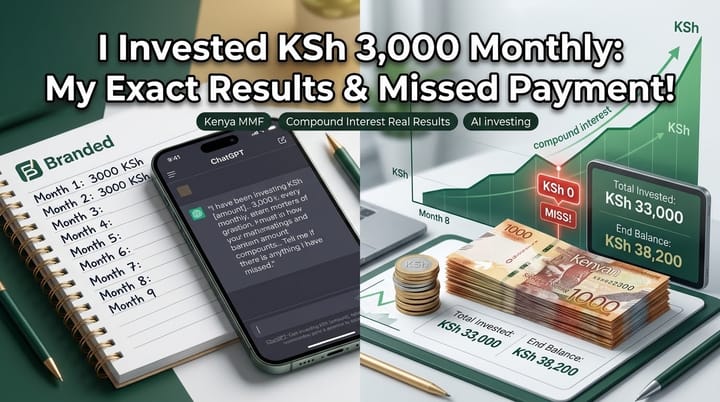
So I opened ChatGPT and typed the most honest financial summary of my life into a chat window. Salary. Expenses. Debts. What I had. What I wanted. I asked it to tell me exactly where to start.
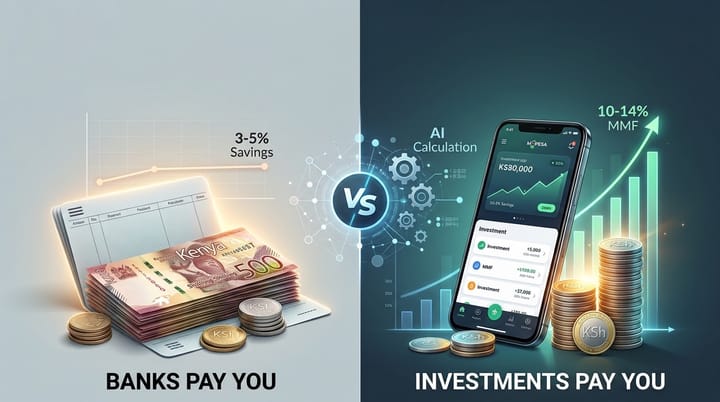
The response was the clearest financial plan I had ever seen for my specific situation. It told me correctly, that my first priority was not investing. It was building an emergency fund of three months of expenses (KSh 105,000) in a money market fund. Not a savings account. A money market fund, earning 12%, accessible within three business days.
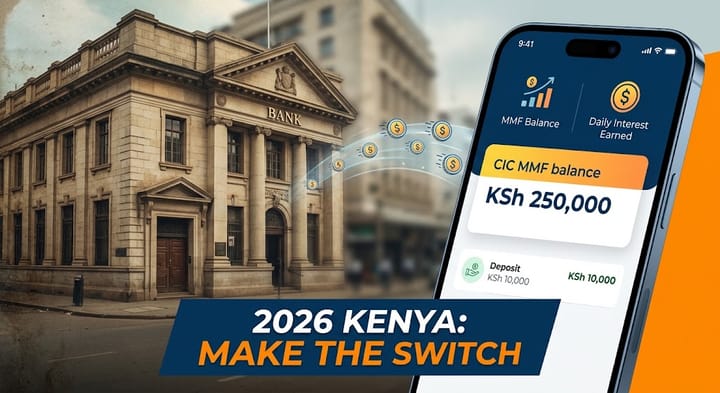
I had never opened a money market fund. I did not know CIC offered one. I did not know the minimum was KSh 1,000. I did not know I could deposit via M-Pesa. Within 48 hours of that conversation, I had an account and had made my first deposit of KSh 8,000.
💡 AI PROMPT: "I earn KSh [salary] monthly in Nairobi. My fixed expenses are KSh [amount]. I have KSh [savings] and want to start building real wealth. I have no investment accounts and a Fuliza habit I want to break. Tell me exactly where to start in priority order with specific Kenyan products, platforms, and amounts."
Year 1 decisions:
- Opened CIC Money Market Fund - deposited KSh 8,000/month consistently
- Set up automatic M-Pesa transfer on salary day - money left before I could spend it
- Cleared Fuliza balance completely in month 3 - redirected that KSh 3,000/month to the MMF
- Did not invest in anything else - emergency fund first, everything else second
Year 1 result:
By month 12, the MMF held KSh 96,000 just under my three-month emergency fund target. I had earned approximately KSh 7,200 in interest. My emergency fund was essentially complete. The habit of investing before spending was established. And I had proven to myself that I was capable of consistency.
That last part mattered more than the money.
Year 2 - Age 29: The First Real Investment
With the emergency fund established, Year 2 was about taking the next step. I went back to the AI with an updated situation more savings, a clearer picture of my expenses, and a specific new question: what now?
The answer was treasury bills. Specifically the 91-day T-bill, then yielding 15.2%, accessible through the Central Bank of Kenya's DhowCSD platform. The AI walked me through what a treasury bill was, why the risk was essentially zero, how to register on DhowCSD, and what documents I needed.
I had never bought a government security before. I did not know it was accessible to ordinary Kenyans. I assumed it was for institutions or wealthy individuals. It was not. Within two weeks of that conversation, I had submitted my first non-competitive bid at a CBK auction and received my first T-bill at 15.2% annual yield.
💡 AI PROMPT: "I have KSh [amount] in a money market fund and can now invest KSh [amount] per month beyond my emergency buffer. I am in Kenya and want to start using treasury bills. Please explain: what is a non-competitive T-bill bid, how do I participate in a CBK auction through DhowCSD, and how should I split my monthly investment between my money market fund and T-bills at my current level?"
Year 2 decisions:
- Continued MMF contributions - KSh 5,000/month (now for long-term savings, not emergency)
- Added T-bill purchases - KSh 5,000/month building toward first KSh 50,000 auction bid
- Salary increased to KSh 65,000 - extra KSh 7,000 split 50/50 between lifestyle and investment
- Used the AI's 10-question due diligence framework before every new financial decision
Year 2 result:
Portfolio value at end of Year 2: approximately KSh 280,000 across the money market fund and my first treasury bill holdings. Real returns after inflation and tax were meaningfully positive for the first time. The number on the statement and the real purchasing power of my savings were both growing. That combination had never happened before in my financial life.
Year 3 - Age 30: The Nairobi Securities Exchange
By Year 3, I had a solid foundation, a fully-funded emergency reserve, growing T-bill holdings, and a consistent saving habit. The AI, when I gave it my updated financial picture, suggested it was time to start looking at the NSE.
I was nervous. Stocks felt speculative in a way that T-bills and money market funds did not. The AI helped me reframe this: the question was not whether stocks were risky compared to T-bills (they are, in the short term). The question was whether, for money I genuinely would not need for five or more years, the long-term real return of a diversified NSE portfolio justified that short-term volatility. For money with a long horizon, the answer was yes.
I started small. KSh 3,600 into Sasa Invest, enough for a small position in one company. I chose Equity Bank after using the AI to help me understand the company's financials, its East African expansion story, and its dividend history. I bought 50 shares.
Nothing dramatic happened immediately. The shares moved slightly. I checked the price too often for the first two months. Then I stopped checking daily. Then I stopped thinking about short-term price movements and started thinking about quarterly earnings. That shift from trader's mindset to investor's mindset, was the most important thing that happened in Year 3.
💡 AI PROMPT: "I want to buy my first NSE stock in Kenya. I am considering [company name]. Please help me understand: how does this company make money, what are its main risks, what does its recent dividend history look like, and what would I need to believe to be true for this to be a good long-term investment at the current price? I am a beginner, explain the financial metrics simply."
Year 3 decisions:
- Opened Sasa Invest account - minimum KSh 1,000, used M-Pesa
- Allocated Ksh 3,600/month to NSE stocks - started with one company, added a second in month 8
- Reinvested all dividends received - did not withdraw a single shilling of investment returns
- Salary reached KSh 72,000 - increased investment total to KSh 12,000/month
Year 3 result:
Portfolio value at end of Year 3: approximately KSh 520,000. Three investment types now working simultaneously MMF compounding daily, T-bills maturing and rolling over quarterly at improving rates, NSE stocks paying dividends and growing. The system was running mostly on autopilot. The monthly time commitment to portfolio management was under two hours.
Year 4 - Age 31: The SACCO Decision
Year 4 brought a new question I had been avoiding: SACCOs. Several colleagues had been pushing me toward their employer SACCO for years. I had always assumed SACCOs were mainly about loans, a way to borrow money cheaply, not a serious investment vehicle.
The AI corrected this assumption. It explained that while SACCOs are often used for affordable credit, the dividend returns on member deposits typically 8-15% annually are competitive with money market funds, and the loan access they provide can be genuinely valuable for larger financial goals. It also noted that SACCO membership builds over time: the longer you stay and the more you contribute, the better your loan terms become.
I joined Fortune SACCO an open-membership SACCO accessible to private sector workers and began contributing KSh 2,000/month. The return on contributions was approximately 12% in dividends. The real value, I was told by longer-standing members, would come when I needed a loan for a meaningful goal. That conversation planted a seed for the following year.
Year 4 decisions:
- Joined Fortune SACCO - KSh 2,000/month contributions
- Increased NSE allocation - now KSh 5,600/month across three companies
- Refined T-bill strategy - rolling 91-day bills into 182-day as rates shifted
- First salary above KSh 75,000 - invested the full increase
Year 4 result:
Portfolio value at end of Year 4: approximately KSh 800,000. The KSh 1 million milestone was visible. The system was mature four separate investment types, all working, all growing, all requiring minimal active management. The AI had become my quarterly review partner, not my daily decision-maker.
Year 5 - Age 32: The Million
The KSh 1 million crossing happened quietly, on a Tuesday afternoon, when I opened my portfolio tracker and added up the numbers for the month.
MMF balance: KSh 165,000. T-bill holdings (face value): KSh 480,000. NSE stock portfolio (market value): KSh 310,000. SACCO deposits: KSh 145,000. Total: KSh 1,100,000.
No celebration. No dramatic moment. Just a number on a spreadsheet that represented four years and eight months of consistent, boring, patient decisions. And a quiet understanding that the next KSh 1 million would take significantly less time than the first, because compounding accelerates.
The most important thing I want to communicate about reaching this milestone is how ordinary the process was. I did not discover a secret investment strategy. I did not take significant risks. I did not earn an exceptional salary. I just started earlier than I wanted to, stayed consistent longer than felt comfortable, and used a free AI tool to make better decisions than I would have made alone.
📊 THE NUMBERS: At KSh 1,100,000 invested and a blended portfolio return of approximately 12% annually, the portfolio now generates approximately KSh 132,000 per year in returns i.e KSh 11,000 per month without any additional contributions. That monthly figure is still growing. In two to three years at this trajectory, the portfolio returns alone will exceed KSh 15,000/month more than enough to fund continued investment without touching salary.
The Full 5-Year Portfolio Strategy - Year by Year
| Age / Year | Monthly investment | Where it went | Portfolio value (approx.) | Key milestone |
| 28 / Year 1 | KSh 8,000 | 100% money market fund — building emergency fund | KSh 96,000 | Emergency fund complete — 3 months expenses |
| 28-29 / Year 2 | KSh 10,000 | MMF (50%) + T-bills (50%) — once KSh 50K threshold hit | KSh 280,000 | First T-bill purchased at 15.5% — real returns begin |
| 29-30 / Year 3 | KSh 12,000 | MMF (30%) + T-bills (40%) + NSE stocks (30%) | KSh 520,000 | First NSE shares purchased via Sasa Invest |
| 30-31 / Year 4 | KSh 14,000 | MMF (20%) + T-bills (30%) + NSE (40%) + SACCO (10%) | KSh 800,000 | SACCO joined — loan eligibility building |
| 31-32 / Year 5 | KSh 15,000 | MMF (15%) + T-bills (25%) + NSE (45%) + SACCO (15%) | KSh 1,100,000 | KSh 1M crossed — portfolio fully diversified |
The pattern is simple: start with the lowest-risk, most accessible option (MMF), add fixed-income government securities once you hit the minimum (T-bills), introduce equity for long-term growth (NSE stocks), and add community credit access (SACCO) as a longer-term tool. Each layer was added only after the previous one was stable.
What the AI Actually Did and What It Did Not Do
I want to be precise about the role AI tools played in this journey, because I think it is often overstated in one direction and understated in another.
What AI genuinely did:
- Built the initial plan - gave me a prioritised, Kenya-specific starting point when I had none
- Explained concepts - every new investment type (T-bills, NSE, SACCOs) was demystified through AI conversations before I committed money
- Ran the numbers - compound interest projections, real return calculations, fee analysis
- Challenged my thinking - when I was excited about something, the AI helped me see the risks I was minimising
- Reduced decision paralysis - having a clear plan meant I spent less time worrying and more time doing
What AI did not do:
- Pick stocks for me - I made all specific investment decisions myself, using AI as a research tool
- Guarantee any outcome - the returns in this story reflect a period of relatively strong MMF and T-bill rates in Kenya
- Replace judgment - I made several decisions differently from what the AI initially suggested, based on my own comfort and circumstances
- Provide real-time data - I used Perplexity AI and the official CBK and NSE websites for current rates and prices
✅ KEY TAKEAWAY: AI tools reduced the knowledge gap between a Kenyan professional with no financial education and the information needed to make good investment decisions. They did not do the investing they made it possible for me to invest more confidently, more consistently, and more intelligently than I would have without them.
How to Replicate This Journey Your Starting Prompt
You do not need to be at the same starting point I was at 28. You do not need KSh 58,000/month. The framework works at KSh 30,000 and at KSh 120,000 the proportions change, the principles do not.
Start here:
"I am [your age] years old, living in Nairobi (or your city), Kenya. My monthly take-home salary is KSh [your amount]. My fixed monthly expenses are approximately KSh [your amount]. I currently have KSh [your savings amount] saved. I have [describe any debts]. My main financial goal is [your goal] within [your timeframe]. I want to build real, diversified wealth using Kenyan investment options available in 2026. Please create a phased, year-by-year investment plan starting from my current situation, with specific platforms, specific Kenyan products, and specific monthly amounts for each stage. Be honest about what is realistic given my numbers."
That prompt is the starting point. The rest is consistency.
The Net Worth Shift
The name of this blog comes from a very specific moment, not the day I crossed KSh 1 million, but the day I realised that the question had shifted.
For most of my 20s, the question was 'how do I afford things?' By my early 30s, the question had become 'how do I deploy this money well?' That is the net worth shift. Not a number on a spreadsheet. A change in the question you are asking about your financial life.
That shift does not require crossing KSh 1 million. It happens the day you open your first money market fund, make your first consistent investment, and prove to yourself that you are someone who builds — not just someone who spends and saves what is left.
You can start that shift today. On whatever salary you have. With whatever is left after this month's expenses.
The first step is always smaller than you think it needs to be.
Where are you in your financial journey? Share in the comments. I read every one.
📖 RELATED READING: The Complete Guide to Investing in Kenya for Beginners (2026) - the full framework for every investment type mentioned in this story, with step-by-step account opening instructions.
📖 RELATED READING: Curiosity Earned the Cash: 10 Questions to Ask AI Before Any Investment Decision the due diligence framework used at every stage of this 5-year journey.
Disclaimer
This article is published by The Net Worth Shift for educational and informational purposes only. The financial journey described uses realistic illustrative figures individual outcomes vary based on income, expenses, investment choices, market conditions, and many other factors. Past performance of any investment type does not guarantee future results. Money market fund returns, T-bill rates, and NSE stock performance used in this post are approximate historical ranges actual current rates may differ significantly. Nothing in this article constitutes personalised financial advice. Investment involves risk including possible loss of principal. Consult a professional licensed by Kenya's Capital Markets Authority (CMA) at cma.or.ke before making significant investment decisions.