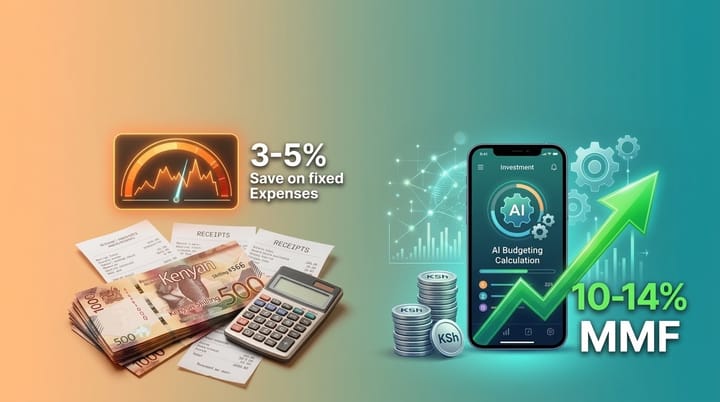
How to Use AI for Personal Finance in Kenya: The Complete Beginner's Guide (2026)
how to use AI for personal finance Kenya ChatGPT budgeting Kenya, AI financial planning Kenya, free AI tools money Kenya, Claude AI investing Kenya

A few months ago, I sat down with a free AI tool, typed in my salary and my expenses, and asked it to build me a personal budget. What came back was more detailed, more personalised, and more actionable than anything I had ever produced in a spreadsheet and it only took four minutes.
I then asked it to suggest where I should be investing based on my situation. It laid out a clear, Kenya-specific plan that would have cost me KSh 5,000 to get from a financial advisor. It was free.
That is not a magic trick. It is not hype. It is what happens when you learn how to talk to an AI tool with intention, giving it the right information and asking the right questions. This guide will teach you exactly how to do that.
By the end, you will know which free AI tools work best for personal finance in Kenya, the exact prompts to use for budgeting, investing, and financial planning, what AI tools can and cannot do with your money, and how to build a system that makes managing your finances genuinely easier.
✅ KEY TAKEAWAY: AI tools will not manage your money for you, but they will help you think about it more clearly, more consistently, and more strategically than most people ever do. That shift in thinking is where the real value is.
1. What Can AI Actually Do for Your Finances?
Before we get into tools and prompts, let us be honest about what AI can and cannot do. This matters because the people who get the most out of AI tools are the ones who use them correctly not the ones who expect them to do everything.
What AI tools are genuinely good at:
- Explaining financial concepts in plain language, no jargon, no assumptions about your background
- Creating personalised budgets based on your actual income and expenses
- Comparing investment options and explaining the trade-offs between them
- Running compound interest calculations and long-term projections
- Helping you prepare for financial conversations with a bank, a SACCO, or an advisor
- Summarising financial news and explaining what it means for you
- Generating ideas for reducing expenses or increasing income
- Answering follow-up questions endlessly without getting impatient or charging per hour
What AI tools cannot do:
- Access your real bank accounts or M-Pesa balance (unless you give them the numbers)
- Guarantee that any investment will perform as projected
- Provide legally binding financial advice
- Know the current interest rates unless you tell them or they have web search access
- Make decisions for you ,they can only inform your decisions
⚠️ IMPORTANT: AI tools including ChatGPT and Claude can produce outdated, incomplete, or incorrect information especially about specific current rates, fund performance, or regulatory requirements. Always verify important financial details directly with the relevant provider or institution before acting on them.
2. The Best Free AI Tools for Personal Finance in Kenya (2026)
You do not need to pay anything to get started. Every tool in this table has a free tier that is more than sufficient for personal finance work. The paid versions offer higher usage limits and additional features, but for most Kenyans getting started, free is enough.
| Tool | Cost | Best for | Skill level | Works in Kenya? |
| ChatGPT (GPT-4o) | Free/$20/mo | Budgeting, planning, analysis | Beginner | Yes - browser |
| Claude (Anthropic) | Free/$20/mo | Long analysis, detailed plans | Beginner | Yes - browser |
| Microsoft Copilot | Free | Quick research, summaries | Beginner | Yes - browser |
| Gemini (Google) | Free | Google Sheets integration | Beginner | Yes - browser |
| Perplexity AI | Free | Live financial news & rates | Beginner | Yes - browser |
| Notion AI | $10/mo add-on | Budget tracking in Notion | Intermediate | Yes - app/browser |
| Cleo | Free / $5.99/mo | Spending analysis, savings nudges | Beginner | Limited - check app |
For a deeper look at seven specific AI tools and how each one applies to investing in Kenya — including one that most beginners overlook, read our guide: 7 Free AI Tools for Investing in Kenya in 2025.
Which one should you start with?
Start with ChatGPT. It has the largest knowledge base, the most intuitive interface, and the widest range of financial applications. Create a free account at chat.openai.com and use the prompts in the sections below. Once you are comfortable, Claude is worth exploring because it produces more structured, detailed analysis for longer financial planning tasks.
3. How to Use AI for Budgeting Step by Step
Budgeting is the foundation of every financial improvement. If you do not know where your money is going, you cannot direct it somewhere better. AI makes building a realistic, personalised budget faster and easier than any spreadsheet method.
The budgeting prompt
Open ChatGPT and paste this, filling in the brackets with your real numbers:
"I live in Nairobi, Kenya. My monthly take-home salary is KSh [your amount]. My fixed monthly expenses are: rent KSh [amount], transport KSh [amount], food KSh [amount], utilities KSh [amount], phone KSh [amount], and other fixed costs KSh [amount]. My variable spending (eating out, shopping, entertainment) is roughly KSh [amount] per month. I have KSh [amount] in savings. Please build me a detailed monthly budget using the 50-30-20 framework, adapted for my actual numbers and Kenyan cost of living. Show me where I am overspending and what I could realistically save and invest each month."

What it gives you
A complete breakdown of your income allocation, specific recommendations for where to cut, a savings and investment target for your income level, and a comparison of your current spending to the recommended split. The output is not generic it responds to the exact numbers you give it.
Follow-up prompts to go deeper
- "What are five practical ways I can reduce my food and transport spending in Nairobi without significantly affecting my quality of life?"
- "Show me what my budget looks like if I increase my investment allocation from 10% to 20% of my salary. What would I need to cut?"
- "If I have a monthly loan repayment of KSh [amount], how does that affect my recommended budget split? Should I prioritise paying off the loan or investing?"
- "Create a simple budget tracker template I can fill in each month to monitor whether I am sticking to this plan."
💡 AI TIP: The more specific the numbers you give an AI, the more useful the output. Do not round your salary to a nice number or estimate your expenses instaed use the real figures. A budget built on real numbers is actually usable. One built on estimates is just a wishful thinking document.
4. How to Use AI for Investment Planning in Kenya
This is where AI tools become genuinely powerful for Kenyans because the gap between what financial advisors charge and what most people can afford is wide. AI bridges that gap.
The investment planning prompt
"I live in Kenya. My monthly take-home salary is KSh [amount]. After expenses, I have approximately KSh [amount] available to invest each month. I am [your age] years old and my main financial goal is [your goal — e.g. build an emergency fund, save for a home, build long-term wealth, retire comfortably]. My risk tolerance is [low / medium / high]. Please create a specific, realistic investment plan using only investment options available in Kenya in 2025. Include the name of specific funds or platforms for each option, how much to put in each monthly, and in what order I should build this portfolio as my savings grow."
Understanding the output
The AI will typically produce a phased plan starting with emergency fund basics in a money market fund, building toward treasury bills and NSE stocks as your balance grows. It may reference fund names and platforms but verify all of these directly with the providers before investing, as the AI's information may be months old.
For a complete guide to money market funds specifically including current rates and how to open an account see: Money Market Funds in Kenya: The Complete 2026 Guide.
Investment follow-up prompts
- "If I invest KSh [amount] per month in a money market fund returning 12% annually, what will I have after 1, 3, 5, and 10 years? Show me the breakdown of principal versus interest."
- "Explain the difference between a 91-day T-bill, a 182-day T-bill, and an infrastructure bond in Kenya. Which is best for someone with KSh 100,000 to invest for the first time?"
- "I want to start buying NSE stocks. Explain what I need to do to open a CDS account in Kenya and what documents I will need. Which stockbroker platform is best for a beginner?"
- "What is the withholding tax rate on money market fund distributions in Kenya, and what is my actual after-tax return at a 12% gross yield?"
📊 BY THE NUMBERS: According to industry data, the average Kenyan who gets personalised financial advice manages their money more effectively than one who does not, but fewer than 10% of working Kenyans have ever consulted a financial advisor. AI tools are not a perfect substitute, but they make informed financial thinking available to anyone with a smartphone.
5. How to Use AI for Debt Management
Debt, particularly high-interest mobile loans is one of the biggest drains on Kenyan household finances. AI tools can help you build a clear, prioritised plan to get out of debt faster.
The debt payoff prompt
"I have the following debts in Kenya: [list each debt with the name, balance, monthly payment, and interest rate e.g. Fuliza: KSh 8,000 at 1.083% per day; Bank loan: KSh 150,000 at 14% per year; SACCO loan: KSh 80,000 at 1% per month on reducing balance]. My monthly surplus after expenses is KSh [amount]. Please build me a debt payoff plan using the avalanche method (highest interest first). Show me how long it will take to clear all debt, how much total interest I will pay, and how much I will save compared to paying minimums only."
Why the avalanche method matters for Kenya
Mobile loan products like Fuliza, M-Shwari, and various digital lenders charge extremely high effective annual rates, sometimes exceeding 300% when daily rates are annualised. The avalanche method targets these first, which can save tens of thousands of shillings in interest compared to paying debts in random order.
Debt follow-up prompts
- "What is the effective annual interest rate of a loan charging 1.083% per day? How does this compare to a bank loan at 14% per year?"
- "Should I use my savings to pay off my Fuliza balance or keep the savings in a money market fund? Show me the maths."
- "Once I have cleared my high-interest debt, how should I redirect those monthly payments toward investment? Build me a transition plan."
6. How to Use AI to Learn About Personal Finance
One of the most underused applications of AI tools is simply education. Most Kenyans were never taught personal finance at school. AI gives you a patient, always-available tutor who will explain anything from basic concepts to advanced strategies in plain English, at your exact level.
Learning prompts for Kenyan financial topics
- "Explain what a unit trust is in Kenya as if I have never invested before. Use a simple example with KSh amounts."
- "What is the Capital Markets Authority and why does it matter that I only invest through CMA-licensed firms?"
- "Explain compound interest using a real example: KSh 5,000 per month invested for 20 years at 11% annual return. Show me the numbers year by year."
- "What is the difference between a SACCO and a bank in Kenya? When is a SACCO a better choice?"
- "Explain Kenya's tax treatment of different investment types; money market funds, dividends, bond interest, and capital gains."
- "What is inflation and how does it affect the real value of my savings? Give me a Kenya-specific example."
The key to learning effectively with AI is to ask follow-up questions. When it explains something you do not understand, type 'explain that more simply' or 'give me another example with smaller numbers.' It will never make you feel embarrassed for asking.
💡 AI TIP: Build a dedicated ChatGPT conversation for your financial education. Save it and return to it regularly adding new questions as they come up. Over time you will have built a personalised financial education curriculum that exactly matches your knowledge gaps and your Kenyan context.
7. How to Build an AI-Assisted Financial System
The biggest mistake people make with AI tools is using them once and forgetting about them. The real power comes from building a simple, repeatable system, a set of prompts and habits that you return to monthly.
The monthly financial review - 20 minutes, once a month
- Pull your numbers: total income received, total spent by category, total saved and invested this month
- Open ChatGPT and use this prompt:
- "Here are my actual financial numbers for [month]: Income KSh [amount]. Spending: rent KSh [amount], food KSh [amount], transport KSh [amount], other KSh [amount]. I saved KSh [amount] and invested KSh [amount]. My investment balance is now KSh [amount]. Compare this to my target budget and tell me: where did I overspend, what went well, and what should I focus on next month?"
- Read the output and pick one specific thing to improve next month
- Ask: 'What is one thing I can do differently next month to improve my financial position by the smallest possible action?'
- Save the conversation because your financial history becomes more useful over time as the AI can compare months
Quarterly investment review - 30 minutes, every 3 months
- Check your money market fund current yield against the top three competitors
- Ask the AI to compare current T-bill rates and whether they still make sense for your portfolio
- Review your progress against your 12-month financial goal
- Ask: 'Based on my current balance of KSh [amount] and monthly investment of KSh [amount], am I on track to reach my goal of KSh [amount] by [date]? If not, what needs to change?'
8. What AI Cannot Replace - The Human Elements
AI tools are powerful, but there are specific financial situations where human professional judgment remains essential. Knowing the boundary makes you a smarter user of both.
When you still need a human advisor:
- Complex tax planning especially if you have multiple income streams, business income, or investment income above KSh 300,000 annually
- Estate planning, wills, and inheritance - these require legal professionals
- Business financing decisions above KSh 1 million
- Pension and retirement planning for formal sector employees - understanding your NSSF benefits and any employer pension scheme
- When you are about to make an irreversible decision - selling property, taking a very large loan, or making a major investment
- For everything else like day-to-day budgeting, understanding investment options, comparing products, learning concepts, running projections, AI tools are excellent starting points that save you time and money.
⚠️ IMPORTANT: Never share your actual bank account numbers, PIN codes, passwords, or M-Pesa account details with any AI tool. A legitimate AI tool does not need this information to help you with financial planning. Treat AI conversations like conversations with a knowledgeable friend not like a banking portal.
Your Action Plan - Start Using AI for Your Finances Today
You now have everything you need to start. Here is a simple 20-minute action plan to put this guide to work immediately:
- Open ChatGPT at chat.openai.com and create a free account if you do not have one
- Start a new conversation titled 'My Personal Finance Plan add [your name]'
- Paste the budgeting prompt from Section 3 with your real numbers
- Read the output and identify the single most important change it recommends
- Paste the investment planning prompt from Section 4
- Save this conversation because you will return to it monthly
- Set a calendar reminder: 'Monthly finance review with AI' for 20 minutes on the last day of every month
✅ KEY TAKEAWAY: The gap between people who build wealth and people who struggle financially is rarely income or intelligence. It is almost always systems consistent habits applied over time. AI gives you a system that is faster to build, easier to maintain, and more personalised than any spreadsheet or generic budgeting app. Use it.
📖 WHAT TO READ NEXT: The Complete Guide to Investing in Kenya for Beginners (2025), once you have your budget and understand how to use AI tools, this guide shows you exactly where to put your money across money market funds, treasury bills, NSE stocks, and SACCOs.
Disclaimer
This article is published by The Net Worth Shift for educational and informational purposes only. Wakarindi Macharia is not a licensed financial advisor, investment broker, or regulated financial professional. Nothing in this article constitutes personalised financial, investment, tax, or legal advice. AI tools referenced in this guide can produce inaccurate or outdated information — always verify specific rates, fund details, and regulatory requirements directly with the relevant provider before making any financial decision. Investment involves risk including the possible loss of principal. Consult a professional licensed by Kenya's Capital Markets Authority (CMA) at cma.or.ke before making significant investment decisions.