3 AI-Powered Moves to Protect Your Kenyan Salary from Inflation in 2026
Kenya's inflation is quietly eating your salary every month — these 3 AI-powered moves will help you fight back and protect your purchasing power.

You felt it before you could name it.
The unga that cost KSh 140 last year now costs KSh 160. The matatu fare that was KSh 50 in the morning is KSh 70 in the evening. The rent that seemed reasonable when you moved in is now a negotiation you dread every January. Your salary is the same number it was last year. Everything it buys is less.
That is inflation. And in Kenya, where inflation has averaged between 6% and 9% annually over the past decade, it is not a distant economic concept, it is a monthly visitor that arrives without knocking and leaves your wallet lighter every time.
The problem is not just that things cost more. The deeper problem is that most Kenyans' financial strategies were not built with inflation in mind. A savings account. M-Pesa Lock. Maybe a fixed deposit. All of them earning less than inflation is taking. All of them quietly moving your financial position backwards while your statement shows a growing number.
This post gives you three specific, AI-powered moves to fight back, not by earning more, but by making the money you already have work hard enough to outpace what inflation is taking.
📊 THE NUMBERS: On a KSh 60,000 monthly salary, Kenya's 7% annual inflation erodes approximately KSh 4,200 of purchasing power every single year. Over five years, without any pay rise, your KSh 60,000 salary effectively buys what KSh 42,700 bought today. That is not a projection. It is arithmetic.
1. How Much Is Inflation Actually Costing Your Salary?
Before the moves, the number. Because most Kenyans have a vague awareness that inflation is bad but have never calculated exactly what it costs them personally. Here is your salary, applied to Kenya's approximate inflation rate of 7% annually:
| Your salary | After 1yr at 7% inflation | After 3yrs at 7% inflation | After 5yrs at 7% inflation | Purchasing power lost over 5yrs |
| KSh 30,000 | KSh 27,900 | KSh 24,246 | KSh 21,390 | KSh 8,610 per month |
| KSh 50,000 | KSh 46,500 | KSh 40,410 | KSh 35,651 | KSh 14,349 per month |
| KSh 75,000 | KSh 69,750 | KSh 60,614 | KSh 53,477 | KSh 21,523 per month |
| KSh 100,000 | KSh 93,000 | KSh 80,819 | KSh 71,299 | KSh 28,701 per month |
| KSh 150,000 | KSh 139,500 | KSh 121,229 | KSh 106,949 | KSh 43,051 per month |
Find your salary in that table. Look at the five-year column. That is the purchasing power your current financial strategy needs to replace or your standard of living declines by exactly that amount, silently, over the next five years.

The right response to this table is not panic. It is a plan. Specifically, three moves that the right investment vehicles guided by free AI tools can make on your behalf.
💡 AI PROMPT: "My monthly salary in Kenya is KSh [your amount]. Kenya's current annual inflation rate is approximately 7%. Please calculate: how much purchasing power am I losing per month, per year, and over 5 years if my savings earn only 4% annually? What annual return do I need on my investments to stay ahead of inflation after withholding tax? Which Kenyan investment options currently beat this threshold?"
The 3 Moves
🏦 MOVE #1
Move Your Idle Cash to a Real Return Vehicle
Stop paying the inflation tax on money that could be working
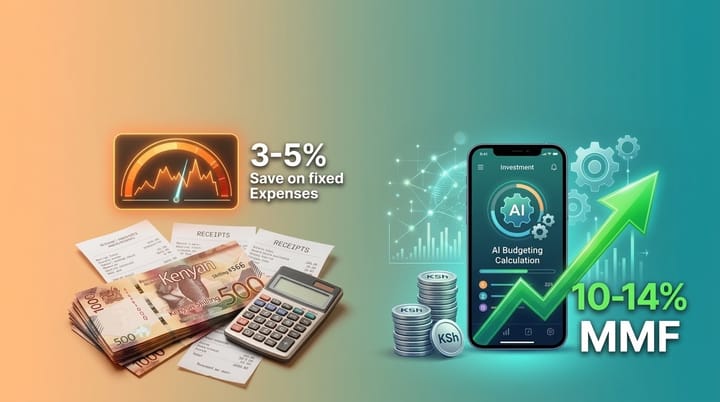
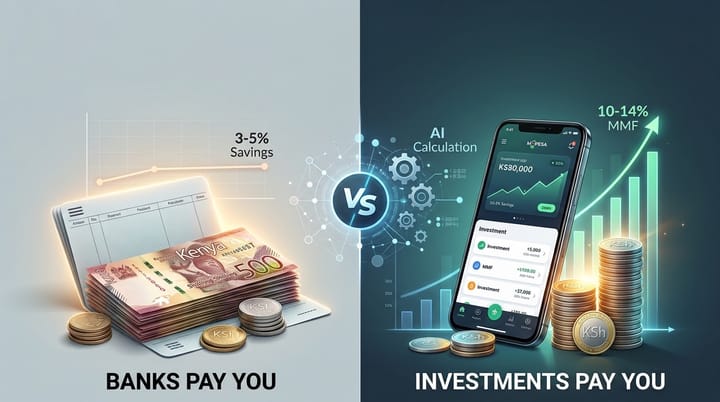
Every shilling sitting in a savings account earning 4% while inflation runs at 7% is paying a 3% annual tax to the economy invisibly, without your permission, without a single notification. The fix is not complicated: move idle cash above your 1-month emergency buffer into a money market fund earning 10-14% annually. The difference between 4% and 12% on KSh 100,000 is KSh 8,000 per year. On KSh 300,000, it is KSh 24,000. That is real money, the equivalent of a month's groceries, a school fees contribution, a meaningful investment addition earned simply by choosing the right vehicle for money you already have.
The action:
Open a money market fund account this week if you do not have one, either CIC, Sanlam, or NCBA are good starting points. Transfer everything above your 1-month emergency buffer from your savings account or M-Pesa Lock to the MMF. Set up an automatic monthly transfer on salary day so future surpluses go directly to the MMF without requiring a decision.
AI prompt to get started
"My savings account earns approximately 4% annually. Kenya's inflation is approximately 7%. I have KSh [amount] in savings and KSh [amount] in M-Pesa Lock. My monthly expenses are KSh [amount]. Please calculate: how much of my savings is above a sensible 1-month emergency buffer? How much purchasing power am I losing monthly on the excess savings sitting in the low-return accounts? If I moved the excess to a money market fund at 12%, how much would I recover per year? Which Kenyan MMF should I open and how?"
✅ KEY TAKEAWAY: Moving idle savings from a 4% account to a 12% MMF does not just stop inflation from winning, it reverses the real return from negative to positive. That single change, on money you already have, is the highest-return move available to most Kenyans.
📈 MOVE #2
Add a Salary-Protecting Fixed Return
Lock in a rate that inflation cannot touch mid-term
Money market funds are excellent, but their returns move with interest rates. When the Central Bank of Kenya cuts rates as it periodically does MMF yields decline, sometimes below what you need to beat inflation comfortably. Treasury bills solve this. When you buy a 91-day or 182-day T-bill at 15%, that rate is fixed for the life of the bill. Inflation can accelerate. Other rates can fall. Your T-bill pays 15% regardless. For money you do not need for 3–6 months, T-bills provide a guaranteed inflation-beating return with zero meaningful risk. In mid-2026, 91-day T-bill rates in Kenya have been consistently yielding 14-17% annually. That is 7-10 percentage points above inflation. That gap is your salary fighting back.
The action:
Register on DhowCSD, Kenya's Central Bank investor portal. The process takes 1-2 days and requires your ID, KRA PIN, and a bank account. Once registered, participate in the next weekly T-bill auction using a non-competitive bid, you accept whatever rate the auction sets, guaranteeing you receive the allocation. Build toward your first KSh 50,000 T-bill purchase by accumulating in your MMF until you hit the minimum.
AI prompt to get started
"The current 91-day Kenya Treasury Bill rate is approximately [rate]% annually. I want to understand: what is my after-tax real return on a T-bill at this rate, assuming 15% withholding tax and 7% inflation? How does this compare to my money market fund? Please also explain the DhowCSD auction process step by step — how do I submit a non-competitive bid, when are auctions held, and how is the interest paid?"
✅ KEY TAKEAWAY: Treasury bills are the most reliable inflation hedge available to ordinary Kenyans, they are government-backed, accessible from KSh 50,000, and fixed at a rate that does not move with market sentiment once you have purchased. Building a rolling T-bill portfolio protects a portion of your savings from both inflation and MMF rate fluctuations.
🤖 MOVE #3
Use AI to Monitor and Adjust Your Inflation Strategy
The gap between your return and inflation changes monthly and your strategy should too
Inflation is not a fixed number. Kenya's inflation rate has moved from 4% to 9% and back within single calendar years. Interest rates move with CBK policy decisions. The investment landscape that was optimal in January may need adjusting by July. Most Kenyans who invest set a strategy once and never revisit it which means they are often fighting last year's inflation with last year's rate environment. This is the move that ties the other two together: a monthly AI-powered review of whether your current investment allocation is still winning the inflation battle. It takes 15 minutes once a month and requires nothing but your current balances and a free AI tool.
The action:
Set a recurring monthly reminder on your phone: 'Inflation check 15 minutes.' On that day, open ChatGPT or Perplexity AI and use the prompt below. Update it with your actual balances and the current inflation and interest rate figures. Act on whatever the AI identifies as your most important adjustment. This single habit, a monthly recalibration is what separates investors who stay ahead of inflation from those who fall behind.
AI prompt to get started
"This month my investment balances in Kenya are: savings account KSh [amount] at [rate]%, money market fund KSh [amount] at [rate]%, T-bills KSh [amount] at [rate]%, NSE stocks KSh [value]. Kenya's current inflation rate is approximately [rate]%. The current 91-day T-bill rate is [rate]%. Please calculate: my blended portfolio return across all holdings, my real return after inflation, whether I am currently ahead or behind inflation, and the single most important adjustment I should make this month to improve my position. Keep the recommendation specific and actionable."
✅ KEY TAKEAWAY: Inflation does not stay still. Neither should your investment strategy. A 15-minute monthly AI review costs nothing and ensures you are always working with current rates and not the rates that existed when you first opened your accounts.
Putting It Together - The Anti-Inflation Stack

The three moves work best in combination. Here is how they layer for a Kenyan earning KSh 65,000/month:
Recommended allocation against inflation (illustrative example):
KSh 1,500 → Keep in savings account (emergency access - accept the inflation cost on this small amount)
KSh 4,500 → Money market fund monthly contribution (liquid growth beating inflation)
KSh 3,000 → Building toward T-bill minimum (once KSh 50,000 reached, roll into quarterly T-bills)
KSh 2,000 → NSE stocks via Sasa Invest (long-term real return above inflation)
Total invested: KSh 11,000/month approximately 17% of a KSh 65,000 salary. Blended annual return on this allocation: approximately 11-13%. Real return after 7% inflation: approximately 4-6% positive. Inflation is no longer winning.
⚠️ REALITY CHECK: This allocation is an illustrative example, not a personalised recommendation. Your ideal split depends on your emergency fund status, existing debts, risk tolerance, and financial goals. Use the AI prompt in Move #3 to calculate your specific optimal allocation based on your real numbers.
The Appetite That Wins
Inflation has an appetite. It will eat whatever you leave in its path from savings accounts, M-Pesa Lock, fixed deposits that do not keep pace. It is patient, consistent, and completely indifferent to how hard you worked for the money it consumes.
But the investments on this page have an appetite too. A money market fund compounding daily. A T-bill locked at 15%. An NSE portfolio growing with Kenya's most resilient companies. These have an appetite for your financial future and in 2026, armed with free AI tools that do the maths in seconds, there is no longer any excuse for letting inflation have it first.
Your salary is working hard for you. Make sure the money it generates works just as hard in return.
Which move are you making first? Let me know in the comments.
📖 RELATED READING: A Penny Saved Is a Penny Lost: Why Your Kenyan Savings Account Is Working Against You - the full breakdown of why savings accounts lose to inflation and exactly where to move your money.
📖 RELATED READING: The Complete Guide to Investing in Kenya for Beginners (2026) - covers all four investment types in this post with step-by-step account opening instructions for each.
Disclaimer
This article is published by The Net Worth Shift for educational and informational purposes only. Inflation rates, interest rates, and investment returns cited are approximate and based on publicly available data as of mid-2026 since they are subject to change and vary over time. The salary impact table is illustrative and based on a consistent 7% annual inflation assumption. Actual inflation varies year to year. Nothing in this article constitutes personalised financial advice. Investment involves risk including possible loss of principal. Always verify current rates directly with providers and the Central Bank of Kenya. Consult a professional licensed by Kenya's Capital Markets Authority (CMA) at cma.or.ke before making significant financial decisions.