Branch Out: The AI Money Move Kenyan Banks Would Prefer You Never Calculated
The AI money move Kenyan banks would prefer you never calculate — it's free, legal, takes 4 minutes, and costs nothing but a decision.
Let me be clear about what this post is before we go any further.
It is not a conspiracy theory. Kenyan banks are regulated institutions doing exactly what they are designed to do, accept deposits, pay depositors a modest rate, and earn the spread by lending that money at higher rates. That business model is not secret. It is published in every bank's annual report and understood by every economist.
What this post is about is the gap. The specific, calculable gap between what your bank savings account pays you and what regulated Kenyan alternatives pay. Because the moment you calculate that gap — using a free AI tool in under four minutes, the next obvious question is why you are still on the wrong side of it.
Most Kenyans never calculate the gap. Not because they lack the intelligence, but because nobody ever suggested they should. Banks are good at making the status quo feel like the safe option. This post is the suggestion.
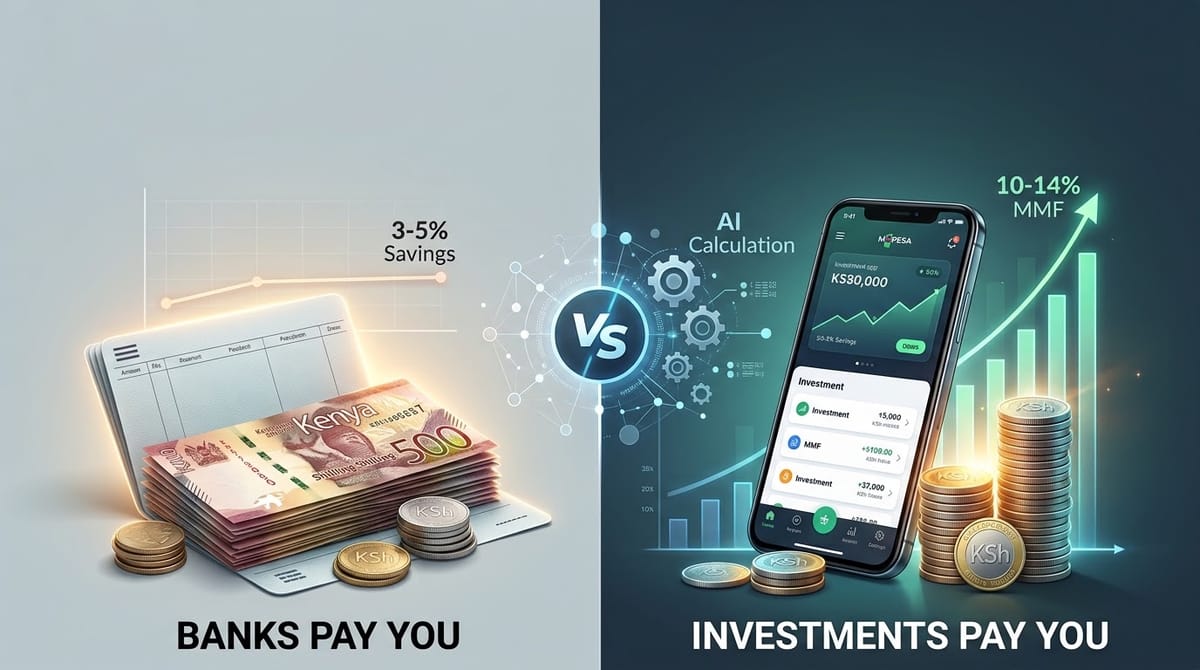
📊 THE NUMBERS: Kenyan savings accounts currently pay 3-5% annually. The top money market funds pay 10-14% annually. On KSh 100,000 in savings, the annual gap is between KSh 7,000 and KSh 10,000. That money is not lost it is sitting in the bank, earning returns they never passed on to you.
1. The Gap Shown by Bank, in KSh
Here is the gap applied to the most common Kenyan banks and savings products. Find your bank in the table below:
| Bank / Product | Savings rate | Best MMF alternative | Annual gap on KSh 100K | Your annual loss |
| Equity Bank savings | 3.5% | CIC MMF at 13% | 9.5 pts | KSh 9,500 |
| KCB savings account | 4.0% | Sanlam MMF at 12.5% | 8.5 pts | KSh 8,500 |
| Co-op Bank savings | 4.5% | NCBA MMF at 12% | 7.5 pts | KSh 7,500 |
| NCBA savings | 4.0% | Zimele MMF at 11.5% | 7.5 pts | KSh 7,500 |
| Stanbic savings | 3.5% | CIC MMF at 13% | 9.5 pts | KSh 9,500 |
| M-Pesa Lock | 5.0% | CIC MMF at 13% | 8.0 pts | KSh 8,000 |
The right column is not a projection. It is the difference between what you are earning today and what you could earn in a CMA-regulated money market fund, on the same KSh 100,000, in the same 12 months. Multiply by your actual balance. The number you get is the annual cost of staying where you are.
2. The 4-Minute AI Process - Exactly How It Works
This is the move. Four steps. Four minutes. Free tools only.
Step 1: Find the live gap (60 seconds)
Open Perplexity AI at perplexity.ai, no account needed. Type:
"What are the current interest rates on savings accounts vs money market funds in Kenya in 2026? Compare the top 4 banks with the top 4 MMF providers. Show the gap in percentage points. Cite your sources."
Perplexity pulls live figures with source citations. You see the current gap in under a minute, verified against real data.
Step 2: Calculate your personal cost (90 seconds)
Open ChatGPT at chat.openai.com. Paste this:
"My [bank name] savings account pays [rate]% annually. The top money market fund in Kenya currently pays [rate from Perplexity]. I have KSh [your balance] in this savings account and my monthly expenses are KSh [amount]. Please calculate: (1) How much am I losing annually by keeping my excess savings here versus a money market fund? (2) What specific amount should I transfer immediately, keeping one month of expenses in savings? (3) Which Kenyan MMF do you recommend for my situation and why?"
The output gives you a specific fund, a specific transfer amount, and typically the M-Pesa paybill number to get started.
Step 3: Open the account (20 minutes)
The AI recommends a fund. You open it via M-Pesa. The account opening process for CIC, Sanlam, or NCBA takes under 30 minutes on your phone. For most Kenyans this means: download or access the fund's portal, enter your ID and KRA PIN, make your first deposit via M-Pesa. Done.
Step 4:Set the automatic transfer (2 minutes)
Set up a recurring M-Pesa transfer to the MMF paybill on your salary date. The gap closes automatically every month going forward. The decision is made once and the system runs itself.
✅ KEY TAKEAWAY: The reason most Kenyans do not do this is not complexity, it is that nobody has ever shown them the specific number their specific bank is costing them. Now you have it. The four-minute process above turns that number into a decision and a done account in under an hour.
3. What the Banks Actually Offer and What They Don't Tell You
This is not about banks being dishonest. It is about what they are structurally incentivised to highlight.
A bank's savings account is a product designed to hold your money cheaply. The lower they pay you, the more they keep. Every bank knows the MMF gap exists. None of them will bring it up in a branch meeting or a mobile app notification. That is rational business behaviour, not conspiracy.
What has changed is your access to the calculation. In 2016, comparing savings rates to MMF rates required research, multiple websites, and a spreadsheet. In 2026, it takes one Perplexity search and one ChatGPT calculation. The bank's advantage was information asymmetry. AI has eliminated it.
⚠️ IMPORTANT: Money market funds are not the same as savings accounts in one important way: they are not KDIC-insured. They are regulated by the Capital Markets Authority and invest in government securities and top-tier bank deposits, but they do not carry deposit insurance. For amounts under KSh 500,000, the difference in protection is small and manageable. For amounts above KSh 500,000, consult a CMA-licensed advisor about appropriate allocation.
4. The Only Question That Remains
You now know your bank's savings rate. You know the MMF rate. You know the gap in KSh on your specific balance. You know the four-minute process to close it.
The only remaining question is whether you will do it this week or file this information away with the other things you meant to act on.
For most people, the reason they do not act is not the process because the process takes four minutes. It is the friction of starting something new with money they have been comfortable leaving where it was. That friction is real. It is also the most expensive habit you maintain.
Your bank is excellent at processing payments, keeping your salary safe, and powering your M-Pesa. It is not excellent at growing your money. In 2026, those are two different jobs, and the right tools for each are no longer the same institution.
Share this with someone whose money is still sitting in a savings account.
📖 RELATED READING: Banking on Yesterday: Why Saving Only in a Bank Account in 2026 Is a 2016 Strategy - https://www.thenetworthshift.com/2026/09/%20still-saving-bank-account-2026-kenya.html the full breakdown of what changed in Kenya's savings landscape over the past decade.
📖 RELATED READING: Money Market Funds in Kenya: The Complete 2026 Guide the step-by-step guide to opening your first MMF account, https://www.thenetworthshift.com/2026/07/money-market-funds-kenya-complete-guide.html with a full comparison of providers.
Disclaimer
This article is published by The Net Worth Shift for educational purposes only. Interest rates cited are approximate mid-2026 figures and subject to change first verify directly with banks and fund providers. Nothing here constitutes financial advice. Money market funds are CMA-regulated but not KDIC-insured. Consult a CMA-licensed professional at cma.or.ke before significant financial decisions.