10 Questions to Ask AI Before Investing a Single Shilling in Kenya.
10 questions every Kenyan investor should ask a free AI tool before putting money anywhere from understanding real returns to checking provider legiti

The most expensive investment mistakes rarely happen because someone chose the wrong stock or the wrong fund. They happen because someone skipped the questions they should have asked before investing at all.
Questions like: Do I actually understand what I am investing in? What is my real return after inflation? What are the specific risks to this particular product? What am I not thinking about?
For most of Kenyan financial history, getting honest, personalised answers to these questions required either an expensive advisor or trusting your own incomplete research. In 2026, a free AI tool can walk you through all ten of these questions in under an hour before you commit a single shilling.
This post gives you the exact questions and the exact prompts. Bookmark it. Use it every time you are about to invest in something new.
⚠️ WATCH OUT: These questions are designed to help you think more clearly,not to replace professional financial advice. AI tools can make mistakes and may have outdated information. Always verify specific figures directly with providers and consult a CMA-licensed advisor before significant investment decisions.
The 10 Questions - Quick Reference
| # | Question | Category | Best tool | Ask before... |
| Q1 | What does this investment actually do? | Understanding | ChatGPT / Claude | Any investment |
| Q2 | What is my real return after inflation? | Maths | ChatGPT | Savings or fixed income |
| Q3 | What are the specific risks? | Risk analysis | Claude | Any investment |
| Q4 | How does this compare to alternatives? | Comparison | ChatGPT | Choosing between options |
| Q5 | Can I afford to lose this money? | Personal fit | ChatGPT | Any investment |
| Q6 | What do the financial ratios mean? | Stock analysis | ChatGPT | NSE stocks |
| Q7 | How is this taxed in Kenya? | Tax | Claude | Any investment |
| Q8 | Is this provider legitimate? | Safety | Perplexity | Any new provider |
| Q9 | What does my investment timeline look like? | Planning | ChatGPT | Long-term investments |
| Q10 | What am I not thinking about? | Devil's advocate | Claude | Final check, always |
Now let us go through each question in detail with the reasoning behind it and a ready-to-paste prompt for each one.
The Questions
Q1 UNDERSTANDING
What does this investment actually do - in plain English?
This sounds obvious but it is the question most people skip. Before putting money into any investment, a money market fund, an NSE stock, a SACCO product, a bond, or any other instrument, you should be able to explain in two or three sentences what it is and how it generates a return. If you cannot explain it, you do not understand it well enough to invest in it. AI is extremely good at this because it can explain any financial product in plain language at exactly the level of detail you need.
Paste this prompt →
"I am considering investing in [product name] in Kenya. Please explain in plain, simple language: what exactly is this product, how does it generate a return for me, where does my money actually go when I invest, and what is the main risk I am taking by putting money here? Assume I am a complete beginner with no financial background."
Follow-up: "What is the difference between this product and a regular bank savings account? Which is better for my situation and why?"
Q2 MATHS
What is my real return after inflation and tax?
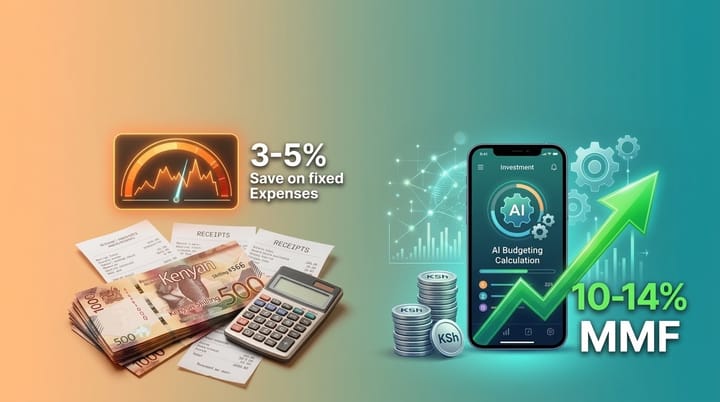
The number on the tin is never the number in your pocket. Every investment return in Kenya is subject to two deductions: inflation (which erodes purchasing power) and withholding tax (deducted at source for most investment income). A money market fund advertising 12% actually pays you approximately 10.2% after 15% withholding tax and if inflation is running at 7%, your real return is approximately 3.2%. That is still excellent. But it is not 12%. Knowing your real return prevents you from comparing investments on headline rates that hide very different true returns.
Paste this prompt →"I am looking at an investment in Kenya with the following headline return: [X]% annually. Please calculate: the return after 15% withholding tax (the standard rate for Kenyan investment income), the real return after subtracting Kenya's current inflation rate of approximately [Y]%, and how much I would actually have after 1, 3, and 5 years if I invest KSh [your amount]. Also tell me if this particular investment type has a different withholding tax rate than 15%."Follow-up: "Compare the after-tax, after-inflation real return of this investment to a 91-day treasury bill at current CBK rates. Which gives me a better real return?"
Q3 RISK ANALYSIS
What are the specific risks - not the generic ones?
Every investment prospectus says 'investment involves risk and you may lose some or all of your capital.' That is legally required but practically useless. The question worth asking is the specific risk profile of this specific investment in Kenya right now. What has historically caused this type of investment to perform badly? What macroeconomic conditions would hurt it? What company-specific or regulatory risks apply? AI is excellent at this kind of structured risk analysis when you give it enough context.
Paste this prompt →
"I am considering investing in [specific investment e.g. EABL shares/ CIC Money Market Fund / a 364-day treasury bond] in Kenya. Please give me a specific, realistic risk assessment not generic disclaimers. Tell me: what conditions have historically caused this type of investment to lose value or underperform? What macroeconomic factors in Kenya right now could hurt this investment? What is the worst realistic scenario for this investment over a 3-year horizon? What would need to happen for me to lose a meaningful portion of my investment?"
Follow-up: "On a scale of low to high, how does the risk of this investment compare to a 91-day T-bill and an NSE blue-chip stock? Explain the comparison simply."
Q4 COMPARISON
How does this compare to my alternatives in Kenya?
Every investment exists within a universe of alternatives. A 10% money market fund return looks excellent compared to a savings account but modest compared to current treasury bill rates. An NSE stock with a 6% dividend yield looks attractive until you compare it to a risk-free T-bill at 15%. Comparing properly accounting for risk, liquidity, minimum investment, and tax treatment, is exactly the kind of structured analysis that takes hours to do manually and minutes to do with AI.
Paste this prompt →
"I am considering putting KSh [amount] into [investment option] in Kenya. Please compare this directly to the following alternatives available to me: [list 2-3 alternatives e.g. CIC Money Market Fund, 91-day T-bill via DhowCSD, and Sasa Invest NSE stocks]. For each option including my chosen one, show me: approximate current return, risk level, minimum investment, how quickly I can access my money, and estimated real return after inflation and tax. Which offers the best risk-adjusted return for my situation?"
Follow-up: "If I wanted to split my KSh [amount] across two of these options to reduce risk, which two would you recommend and in what proportion? Why?"
Q5 PERSONAL FIT
Can I genuinely afford to lose this money or lock it away?
This is the question people answer dishonestly most often not because they are lying, but because they are optimistic. Before any investment, you need to be clear-eyed about two things: can this money stay invested for the required timeframe without being needed for something else, and what is the real impact on your life if this investment performs badly? AI can help you stress-test your own assumptions here by running through specific scenarios.
Paste this prompt →
"I am planning to invest KSh [amount] in [investment type] which has a [timeframe] horizon. My monthly take-home salary is KSh [amount] and my monthly expenses are KSh [amount]. I currently have KSh [emergency fund amount] set aside for emergencies. Please help me assess: do I have sufficient emergency reserves before making this investment, what would happen to my financial situation if this investment lost [X]% of its value, and is this investment amount appropriate for my income level and existing financial obligations?"
Follow-up: "What financial foundations should I have in place before investing in [this specific type of investment]? Am I missing any?"
Q6 STOCK ANALYSIS
What do the financial ratios mean for this specific company?
This question is for NSE stock investors specifically. The numbers that come with a stock listing P/E ratio, dividend yield, earnings per share, return on equity are only useful if you understand what they mean in context. A P/E of 8 might be cheap for one sector and expensive for another. A dividend yield of 7% might be sustainable for one company and a warning sign for another. AI explains these ratios in plain language and in sector context.
Paste this prompt:
"I am researching [company name] on the Nairobi Securities Exchange. Their current metrics are: share price KSh [X], P/E ratio [Y], dividend yield [Z]%, earnings per share KSh [A], and return on equity [B]%. Please explain what each of these numbers means in plain language, whether each one looks healthy, concerning, or neutral for a company in the [sector] sector, and what the overall picture suggests about whether this stock is fairly valued, undervalued, or overvalued at the current price. Do not make a buy or sell recommendation — just help me understand the data."Follow-up: "What additional information from the company's annual report should I look at before making a decision? What are the three most important things to check in their latest financial statements?"
Q7 TAX
How is this investment taxed in Kenya, what do I actually keep?
Kenya's tax treatment of investment income varies by instrument and matters significantly for comparing true returns. Dividend income from NSE stocks is taxed at 5% withholding. Money market fund distributions at 15%. Treasury bill and bond interest at 15%, except infrastructure bonds, which are tax-exempt. Capital gains on NSE stocks are currently exempt. Getting this wrong means comparing headline rates that represent very different after-tax returns. AI gives you a clear breakdown by instrument.
Paste this prompt:
"Please explain the tax treatment of investment income in Kenya for each of the following: money market fund distributions, NSE stock dividends, NSE stock capital gains, 91-day treasury bill interest, infrastructure bond interest, and SACCO dividend income. For each one: what is the withholding tax rate, who deducts it, and does it reduce the return I see or is it paid separately? I want to understand the after-tax return for each type of investment."
Follow-up: "If I want to minimise my tax burden on investment income in Kenya legally, which combination of investment types would give me the best after-tax return? What role do infrastructure bonds play in that strategy?"
Q8 SAFETY
Is this provider legitimate and regulated?
Kenya has had numerous high-profile investment fraud cases, schemes that promised extraordinary returns and collected billions of shillings from trusting investors before collapsing. The pattern is consistent: promises of 30%, 50%, or higher returns; urgency to invest now; pressure through WhatsApp or social media; no verifiable regulatory registration. AI can help you build a verification checklist and guide you to the right regulatory databases to confirm a provider is legitimate before sending any money.
Paste this prompt
"I am considering investing with [provider name] in Kenya, who is offering [describe the investment and returns promised]. Please help me build a legitimacy checklist: what regulatory body should a legitimate Kenyan investment provider be registered with for this type of product, what are the warning signs of investment fraud in Kenya, and what specific questions should I ask this provider or check online before investing? Also tell me if the promised return of [X]% is consistent with legitimate investment products in Kenya right now or sounds suspicious."
Follow-up: "Where exactly can I verify whether [provider name] is licensed by the Capital Markets Authority of Kenya? What other checks should I run?"
Q9 PLANNING
What does my investment look like over time, year by year?
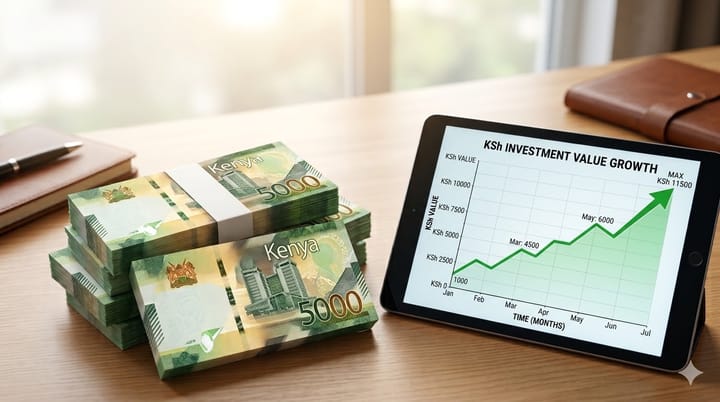
Most investment projections show you a single final number: 'KSh 1 million in 10 years.' What that number hides is the journey, the year-by-year growth, the compounding curve, and crucially, what happens if you need to stop contributing for a period. Seeing the year-by-year projection makes the plan feel real and helps you make better decisions about contribution amounts and timelines.
Paste this prompt
"I plan to invest KSh [amount] per month in [investment type] returning approximately [X]% annually. I am starting with KSh [initial lump sum if any]. Please show me a year-by-year projection for 10 years: how much I have contributed in total each year, how much interest or returns I have earned, what my total balance is, and what percentage of my final balance came from my own contributions versus investment returns. Also show me what happens to my projection if I stop contributing for 6 months in Year 3 then resume how much does that gap cost me?"
Follow-up: "At what point does my investment income (returns) overtake my monthly contributions in terms of monthly growth? Show me when compounding starts doing more work than my contributions are."

Q10 DEVIL'S ADVOCATE
What am I not thinking about, what could go wrong that I have not considered?
This is the most important question on the list and the one almost nobody asks. It is human nature to seek information that confirms what we already want to do. A good financial advisor challenges your assumptions. AI does the same when you ask it to. Q10 is your built-in stress test, give the AI your investment plan and ask it to argue against it. The goal is not to talk yourself out of investing. It is to make sure you have genuinely considered the things you might be glossing over.
Paste this prompt
"I am planning to [describe your investment decision in detail what you are investing in, how much, for how long, and why you think it is a good idea]. Please take the role of a cautious, experienced financial advisor and tell me everything that could go wrong with this plan that I might not have considered. Challenge my assumptions. Point out any risks I may be minimising or overlooking. Identify anything in my plan that experienced investors would question. Be honest and direct, I want a genuine challenge to my thinking, not reassurance."
Follow-up: "Given everything you have just raised, do the potential risks change your overall assessment of this investment plan? What would you change about it to make it more robust?"

How to Use All 10 Questions Together
You do not need to ask all ten questions every time you consider an investment. Here is how to prioritise based on what you are evaluating:
For any investment you have never used before - ask all 10
New to money market funds? New to NSE stocks? New provider you have not used? Go through the full list. It takes 45–60 minutes and saves you from the most avoidable mistakes.
For a familiar investment type you are adding to - ask Q2, Q3, Q9, Q10
Adding more to your existing money market fund or buying more shares of a company you already hold? You understand the product, focus on the maths, the current risk environment, your updated projections, and the devil's advocate check.
For any investment promising unusually high returns - ask Q8 first
If something is promising more than 20% annual returns in Kenya, go straight to Q8, do a legitimacy check before anything else. No other question matters if the provider is not real.
Monthly portfolio review - ask Q9 and Q10
Once a month, run your updated numbers through Q9 to see whether you are on track, and Q10 to challenge your current plan with fresh eyes.
✅ KEY TAKEAWAY: The ten minutes you spend asking these questions before investing will save you from decisions you cannot take back. Print them, bookmark this page, share it in your investment WhatsApp group. The best investment you can make before any financial decision is the decision to think clearly first.
Question Time - Final Thought
In Kenya's financial landscape, the investors who consistently build wealth are not necessarily the ones who find the best investments. They are the ones who avoid the worst ones like the fraud schemes, the over-concentrated portfolios, the investments they did not understand, the money locked away when they needed it for an emergency.These ten questions will not make you a financial genius. But they will make you a significantly harder person to mislead and definately a significantly more deliberate person about where your money goes.
Save this post. Use it every time the question 'should I invest in this?' crosses your mind.
Which of these 10 questions do you find most useful? Tell me in the comments.
📖 RELATED READING: How to Use AI for Personal Finance in Kenya: The Complete Beginner's Guide (2026) the full guide to using ChatGPT, Claude, and Perplexity AI across budgeting, investing, and financial planning. https://www.thenetworthshift.com/2026/08/free-ai-tools-investing-kenya-2026.html
📖 RELATED READING: 7 Free AI Tools for Investing in Kenya in 2026 the specific tools to use for each of the 10 questions above, with additional prompts for each one. https://www.thenetworthshift.com/2026/08/free-ai-tools-investing-kenya-2026.html
Disclaimer
This article is published by The Net Worth Shift for educational and informational purposes only. Nothing here constitutes personalised financial, investment, tax, or legal advice. AI tools can produce inaccurate or outdated information, always verify specific rates, provider details, and regulatory status directly with the relevant institution. Investment involves risk including possible loss of principal. Consult a professional licensed by Kenya's Capital Markets Authority (CMA) at cma.or.ke before making significant investment decisions.