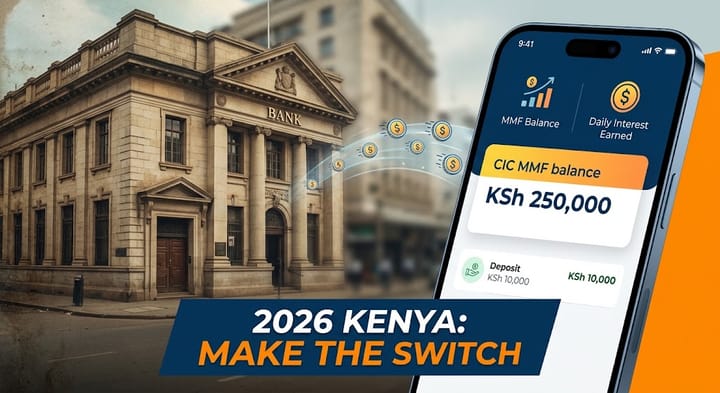
Why Your Kenyan Savings Account Is Working Against You and Three Better Places to Put Your Money
Discover why bank savings accounts lose money to inflation in Kenya. Explore better options to save and invest in 2026, including money market funds.
Benjamin Franklin said 'a penny saved is a penny earned.'
Benjamin Franklin did not have to deal with Kenyan inflation.
In 2026, a penny saved in a Kenyan bank savings account is, mathematically, a penny that is slowly losing its value. Not dramatically. Not in a way that shows up on your monthly statement. Quietly, consistently, and with perfect politeness. Your bank account is shrinking your purchasing power while showing you a growing balance.
This is not the bank's fault. They are doing exactly what savings accounts are designed to do, hold your money safely and pay you a modest interest rate. The problem is not the account. The problem is when Kenyans use a savings account as an investment vehicle when it is designed to be a holding place.
This post is going to show you exactly how much your savings account is costing you in real terms, why the proverb needs an update for 2026 Kenya, and three specific alternatives that actually grow your money faster than inflation starting from as little as KSh 1,000.
📊 THE MATHS: A Kenyan with KSh 200,000 in a savings account earning 8% annually will have KSh 216,000 after 12 months an apparent gain of KSh 8,000. But with inflation at 7%, that same KSh 200,000 of purchasing power now requires KSh 214,000 to match. Real gain after inflation: approximately KSh 2,000. On KSh 200,000. For a full year of waiting.
1. The Invisible Tax - How Inflation Quietly Erodes Your Savings
Inflation is the rate at which prices rise over time. When inflation runs at 7% annually, everything from food, rent, transport, school fees, medical care costs 7% more on average than it did a year ago.
Your salary may or may not keep pace with that. But your savings account interest rate almost certainly does not.
Here is the calculation that most Kenyans have never seen applied to their own money:
Real return = Interest rate earned - Inflation rate
Example: KSh 100,000 in a savings account at 4% interest, with 7% inflation
Interest earned: KSh 4,000
Purchasing power lost to inflation: KSh 7,000
Net real return: −KSh 3,000
Your statement says you earned KSh 4,000. Your purchasing power says you lost KSh 3,000. Both are true simultaneously. The statement is not lying, but it is not telling you the whole story either.
Now scale that up. KSh 500,000 sitting in a savings account at this differential loses approximately KSh 15,000 in real purchasing power every year. Over five years without withdrawing a single shilling — you have effectively given away KSh 75,000 in lost purchasing power, even though your statement shows a higher balance every month.

⚠️ REALITY CHECK: The gap between your savings account interest rate and Kenya's inflation rate is not constant. When the Central Bank of Kenya (CBK) raises interest rates as it did aggressively in 2023 savings account rates and money market fund returns both rise. When rates fall, the gap narrows. The core principle remains: always know your real return, not just your nominal return.
2. Where Every Major Savings Option Stands - The Honest Comparison
The chart below shows how different places to put your money compare on real returns — after accounting for Kenya's current inflation environment. All figures are approximate and subject to change.
| Where your money is | Typical annual return | Inflation rate (Kenya) | Real return | Verdict |
| Bank savings account | 3–5% | 6–9% | Negative 1–6% | ❌ Losing value |
| M-Pesa Lock / Savings | 4–6% | 6–9% | Negative 0–5% | ❌ Barely breaking even |
| Money market fund | 10–14% | 6–9% | Positive 1–8% | ✅ Growing in real terms |
| Treasury bills (91-day) | 14–17% | 6–9% | Positive 5–11% | ✅ Strong real growth |
| NSE stocks (long-term avg) | 10–18% (variable) | 6–9% | Positive (variable) | ✅ Best long-term (with risk) |
Two things stand out immediately. First, bank savings accounts and M-Pesa Lock are both in negative real-return territory at current inflation rates. Second, the alternatives money market funds, treasury bills, and long-term NSE stocks all outpace inflation meaningfully. The gap is not marginal. It is the difference between your money growing and your money shrinking.

💡 AI TIP: Use this prompt to calculate your own real return: 'My savings account in Kenya is paying me [X]% interest annually. Current inflation in Kenya is approximately [Y]%. What is my real return after inflation? If I moved this money to a money market fund returning [Z]%, how much more would I earn in real terms over 1 year, 3 years, and 5 years? Show me the calculation for KSh [your balance].'
3. Three Better Places for Your Money in Kenya - Starting From KSh 1,000
Option 1: Money Market Fund - the savings account upgrade
A money market fund is the most direct substitute for a savings account. It holds your money in low-risk government securities and bank deposits, just like a savings account, but pays significantly higher returns because the fund manager pools your money with thousands of other investors to access better rates.
In 2026, the top Kenyan money market funds are returning between 10% and 14% annually. You can deposit and withdraw via M-Pesa. You can access your money within 1-3 business days. The minimum investment with most providers is KSh 1,000.
- CIC Money Market Fund - consistently strong returns, M-Pesa accessible
- Sanlam Money Market Fund - competitive rates, clean mobile app
- NCBA Money Market Fund - seamlessly integrated with NCBA Loop
The money market fund is where your emergency fund should live, the 3-6 months of expenses you might need quickly. It is not locked. It grows faster than a savings account. And it is just as accessible when you need it.
For a full comparison of Kenyan money market funds with current rates and step-by-step account opening instructions, see: Money Market Funds in Kenya: The Complete 2026 Guide.
Option 2: Treasury Bills - A risk-free returns that beat most alternatives
Treasury bills are issued by the Government of Kenya when it needs to borrow money. You lend the government money for 91, 182, or 364 days and they pay you back with interest. The government has never defaulted on its domestic debt, making these as close to risk-free as any investment in Kenya.
In mid-2026, Kenya's 91-day treasury bill rates have been yielding between 8.78% to 8.83% annually. That is 2x what a savings account pays with zero meaningful risk.
The minimum investment is KSh 50,000, and you invest through the Central Bank of Kenya's DhowCSD platform at dhowcsd.centralbank.go.ke. If you are not yet at KSh 50,000, build your money market fund first and use T-bills once you cross that threshold.
Option 3: NSE Stocks - best long-term real returns, with patience
For money you genuinely do not need for five or more years, NSE stocks have historically delivered the strongest real returns of any Kenyan investment. The combination of dividend income and price appreciation, compounded over a decade, has produced significantly better outcomes than any fixed-income product.
The catch is volatility. Stock prices go up and down, and short-term market movements can be uncomfortable. This makes stocks inappropriate for your emergency fund or money you might need soon. For genuine long-term wealth building, they belong in your portfolio once you have the first two options established.
For a complete beginner's guide to NSE stock investing including how to open a CDS account and which companies to research first, see: NSE Stock Investing for Beginners: The Complete Step-by-Step Guide for Kenyans (2026).
4. 'But Isn't My Money Safer in the Bank?'
This is the question almost everyone asks and it deserves a direct answer.
Your bank savings account is insured by the Kenya Deposit Insurance Corporation (KDIC) up to KSh 500,000. If your bank fails, you get that money back. That protection is real and valuable.
Money market funds are not KDIC-insured. They are regulated by the Capital Markets Authority (CMA) and invest primarily in government securities, but they do not carry the same deposit insurance.
So in terms of pure insurance coverage, yes a bank savings account has more protection than a money market fund for amounts under KSh 500,000.
Here is the question worth sitting with though: what risk are you actually more exposed to? The risk that your regulated, CMA-licensed money market fund investing in government securities will fail? Or the risk that inflation will silently erode 3-5% of your purchasing power every year while you wait safely in a savings account?
Both risks are real. Most financial educators argue that for the vast majority of Kenyans, the inflation risk is far more likely to affect your financial wellbeing than the counterparty risk of a well-regulated money market fund. That is a judgment call you get to make for yourself, but make it with both risks clearly in view, not just one of them.
✅ KEY TAKEAWAY: Keep your emergency fund of 1 to 3 months of essential expenses in a savings account or money market fund for genuine accessibility. Move everything above that threshold into instruments that beat inflation. The savings account earns its place as a short-term buffer. It was never designed to be your wealth-building engine.
5. What to Do With Your Savings Account Right Now - A Practical Plan
You do not need to close your savings account. You need to right-size it. Here is a simple four-step plan:
- Calculate your monthly essential expenses; rent, food, transport, utilities, phone. Add them up.
- Identify how much you currently have in savings. Decide how many months of expenses you want as an emergency buffer may be 1 to 3 months is typically right for someone with stable employment, 3 to 6 months for anyone in variable income or commission-based work.
- Anything above your emergency buffer amount should move to a money market fund. Do this as a single transfer, not gradually. The money sitting in savings above your buffer is losing real value every day it stays there.
- Set up automatic monthly contributions like a Standing Order . On salary day, automatically transfer your investment amount to your money market fund before you have a chance to spend it. What you never see in your current account, you will not miss.
Use AI to build your personalised plan
"I have KSh [your total savings] across a bank savings account and M-Pesa. My monthly essential expenses are approximately KSh [amount]. I want to keep an appropriate emergency fund and move the rest to a better option. Please help me: calculate exactly how much I should keep in my savings account as an emergency buffer, how much I should move to a money market fund immediately, and what my monthly investment amount should be going forward based on my salary of KSh [amount]. Give me specific amounts and specific Kenyan platforms to use in 2026."
The AI will give you a personalised split based on your actual numbers — not a generic recommendation. It takes four minutes and saves you months of guesswork.
6. Updating the Proverb for 2026 Kenya
'A penny saved is a penny earned' made perfect sense in Benjamin Franklin's world in 18th century America, zero inflation, and no alternatives to a physical safe or a mattress. The act of not spending was itself a form of wealth creation.
In 2026 Kenya, the proverb needs a rewrite:
"A penny saved in the right place is a penny multiplied. A penny saved in the wrong place is a penny quietly disappearing."
Saving is still one of the most important financial habits you can build. The question is not whether to save, it is where to save. And in 2026, you have better options than your parents did, more accessible than ever before, starting from KSh 1,000.
The only question that remains is whether you use them.
Share this with someone whose money is sitting in a savings account.
📖 RELATED READING: Don't Bank On It: 5 Investing Mistakes Every Kenyan Under 35 Makes goes deeper into all five money mistakes that cost young Kenyans the most, including the savings account trap and how AI tools help fix each one.
📖 RELATED READING: Money Market Funds in Kenya: The Complete 2026 Guide a full comparison of the top Kenyan money market funds with current rates, minimums, and step-by-step account opening instructions.
Disclaimer
This article is published by The Net Worth Shift for educational and informational purposes only. Nothing here constitutes personalised financial advice. Interest rates, inflation figures, and fund returns cited are approximate and subject to change verify current figures directly with providers and the Central Bank of Kenya. Investment involves risk. Money market funds are not KDIC-insured. Always consult a professional licensed by Kenya's Capital Markets Authority (CMA) at cma.or.ke before making significant financial decisions.