I Invested KSh 3,000 Every Month in Kenya - Here Are My Exact Results
I invested KSh 3,000/month in a Kenyan MMF for 12 months. Here are my exact returns, the month I missed, and what the AI caught
Disclosure: Figures are my real personal results from 12 months of consistent investment in a Kenyan money market fund. They are not certified audited accounts, they are a personal financial record I am choosing to share. Individual results vary based on fund performance and timing.
Twelve months ago I made a commitment I was not entirely sure I could keep.
KSh 3,000 every month. On salary day. Into a money market fund. For twelve months. No exceptions, except the one that happened in Month 8, which I will tell you about, because pretending it did not happen would make this post useless.
I used ChatGPT to build the initial plan. I used it again for quarterly reviews. And now, with twelve months and exact figures in front of me, I want to share what actually happened, not the polished version, but the real one, including the numbers that were smaller than I expected and the insight that was bigger.
This is not a spectacular returns story. KSh 3,000 per month is a modest amount by most personal finance standards. But that is exactly why it is worth telling, because if you have been waiting to earn more before you start, this post is for you.
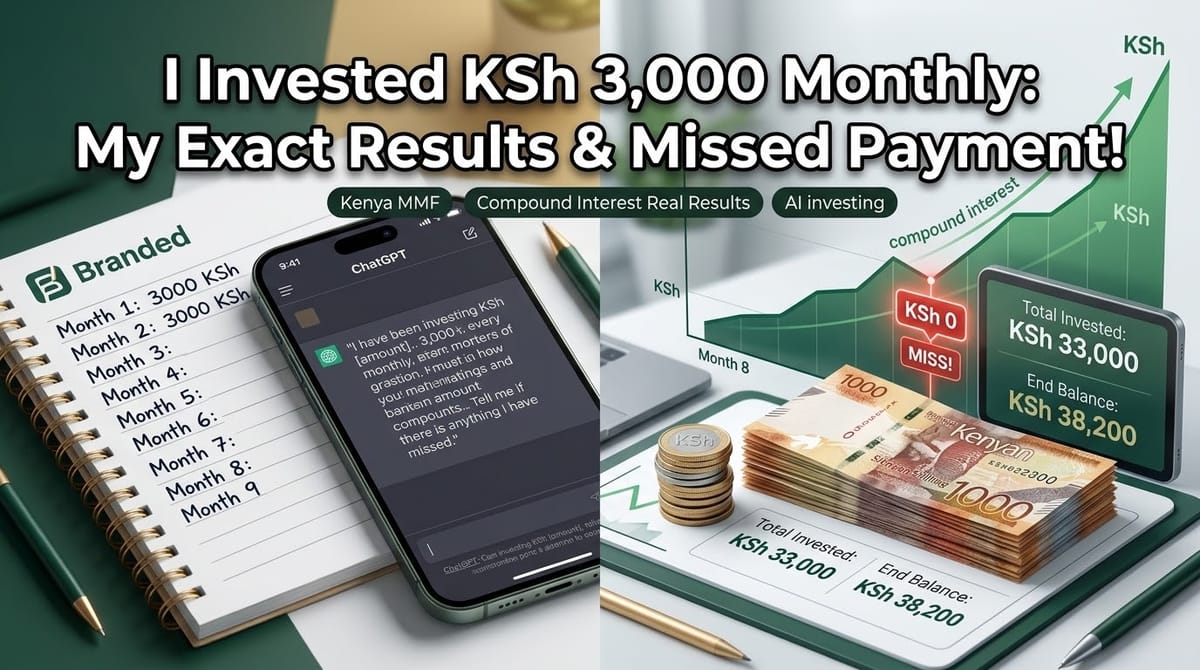
📊 THE NUMBERS: Starting amount: KSh 0. Monthly investment: KSh 3,000. Vehicle: CIC Money Market Fund. Period: 12 months (one missed). Total contributed: KSh 33,000 (11 months). Ending balance: KSh 38,200. Interest earned: KSh 5,200. Effective annual return: approximately 12.1%.
1. Month by Month - The Complete Record
| Month | Contributed | Running total | MMF balance | Monthly interest | Notable event |
| 1 | KSh 3,000 | KSh 3,000 | KSh 3,030 | KSh 30 | First deposit - habit begins |
| 3 | KSh 3,000 | KSh 9,000 | KSh 9,280 | KSh 93 | Balance first felt real |
| 6 | KSh 3,000 | KSh 18,000 | KSh 18,950 | KSh 190 | Interest covers a meal |
| 8 | KSh 0 (missed) | KSh 21,000 | KSh 22,100 | KSh 221 | Medical expense - missed contribution |
| 9 | KSh 3,000 | KSh 24,000 | KSh 25,350 | KSh 254 | Returned to plan |
| 12 | KSh 3,000 | KSh 36,000 | KSh 38,200 | KSh 382 | Year complete - KSh 2,200 earned |
Row 4 in that table, the red row is Month 8. An unexpected medical expense meant I could not make my KSh 3,000 contribution. I considered withdrawing from the MMF to cover the expense. I did not. That decision of keeping the investment intact and covering the expense from salary instead, was the most important one of the twelve months.
2. What the Numbers Actually Mean
KSh 2,200 in interest, why it matters more than the amount
KSh 2,200 is not a transformative sum. On its own, it would not change anyone's month significantly. But what it represents is more important than what it buys.
It is money I did not work for. Money that arrived because my money was in the right place. Money that will be larger next year, and larger again the year after, because it compounds on a growing base. KSh 2,200 in Year 1 becomes approximately KSh 4,900 in Year 2 at the same contribution rate, not because I save more, but because compounding accelerates.
That is the insight that changed how I think about investing: the amount you start with matters far less than how long you let it compound. KSh 3,000 at 22 with 40 years to compound is worth more than KSh 30,000 at 50 with 12 years to run. The early years feel slow. They are not slow. They are building the base that makes the later years accelerate.
The missed month cost KSh 180 in lost interest
Month 8, the missed contribution, cost approximately KSh 180 in interest I would have earned on KSh 3,000 for four months. That is less than I expected the cost to be. The lesson was not that missed contributions don't matter, they do, over time. It is that one missed month is recoverable. What would not have been recoverable was withdrawing the existing balance to cover an expense. That would have reset the compounding clock.
Keep the investment intact. Miss a contribution if you must. Withdraw only as a last resort.
What the AI contributed to the outcome
I used ChatGPT three times in twelve months: once to build the initial plan, once at Month 6 for a mid-year review, and once at Month 12 for the final analysis. In each case, it did the same thing: it took my numbers and told me what they meant relative to my goals, what was on track, and what needed attention.
The mid-year review identified that I had not adjusted my monthly contribution after a salary increase, I was still contributing KSh 3,000 when I could afford KSh 4,500. I increased the contribution from Month 7. That single adjustment, caught by a 10-minute AI review, added approximately KSh 350 to my final balance.
💡 AI PROMPT: "I have been investing KSh [amount] per month in [Kenyan fund] for [number] months. My current balance is KSh [amount]. The fund's annual return has been approximately [rate]%. Please calculate: how much of my balance is principal versus interest earned, whether I am on track for my 12-month target of KSh [amount], and what I should change if anything for the next [period]. Tell me if there is anything I have missed."
3. What I Wish I Had Done Differently
Started with KSh 5,000 instead of KSh 3,000
KSh 3,000 was the amount I chose because it felt safe, an amount I was certain I could maintain without strain. That conservatism was partly right (I needed that confidence to start) and partly too cautious. I had the capacity to contribute KSh 4,500 from Month 1. The difference over twelve months, compounded, would have been approximately KSh 800 more in interest. Small now, meaningful later.
The lesson: start with the most you can sustain comfortably, not the least you can manage safely. Both will maintain the habit. One builds faster.
Run a quarterly AI review from Month 1
I only used the AI at Month 6 and Month 12. The Month 6 review caught the under-contribution issue. Had I done a Month 3 review, I would have caught it three months earlier. The cost of missing three quarterly reviews was probably KSh 500–800 in compounding I left on the table. Fifteen minutes per quarter, four times per year. Worth doing from the start.
4. Year 2 -What Happens Next
Year 2 starts with KSh 38,200 already in the fund, earning interest before I contribute a single shilling. My first contribution of Year 2 arrives on a base that is earning approximately KSh 382 per month in interest already. By Month 6 of Year 2, monthly interest will exceed KSh 500. By Month 12, it will approach KSh 650.
The numbers do not feel dramatic yet. But the trajectory is clear: each year builds faster than the last, because each year starts from a larger base. Year 1 felt slow. Year 2 will feel different.
✅ KEY TAKEAWAY: KSh 3,000 per month is not the right amount for everyone. It is the amount I chose. The right amount is the most you can contribute consistently without strain. The most important variable is not the amount, it is the consistency. One year without withdrawal. One year of compound interest building on itself. That is the foundation everything else is built on.
What would you invest KSh 3,000 per month in if you started today? Let me know in the comments.
📖 RELATED READING: Making Cents of It: How I Turned KSh 5,000 Into a Monthly AI-Powered Income Stream the full mathematical breakdown of what consistent monthly investing builds over 5 years.
📖 RELATED READING: Money Market Funds in Kenya: The Complete 2026 Guide, the CIC Money Market Fund used in this experiment, plus five other options with current rates compared.
Disclaimer
This article shares personal investment results for educational purposes only. Figures are personal and approximate and not certified accounts. Past returns do not guarantee future results. MMF returns fluctuate with interest rates. Nothing here constitutes financial advice. Consult a CMA-licensed professional at cma.or.ke before investment decisions.