Why Saving Only in a Bank Account in 2026 Is a 2016 Strategy and What to Do This Week
Still saving only in a bank account in Kenya in 2026? Here is exactly why that is a 2016 strategy and what to do with your money this week instead.
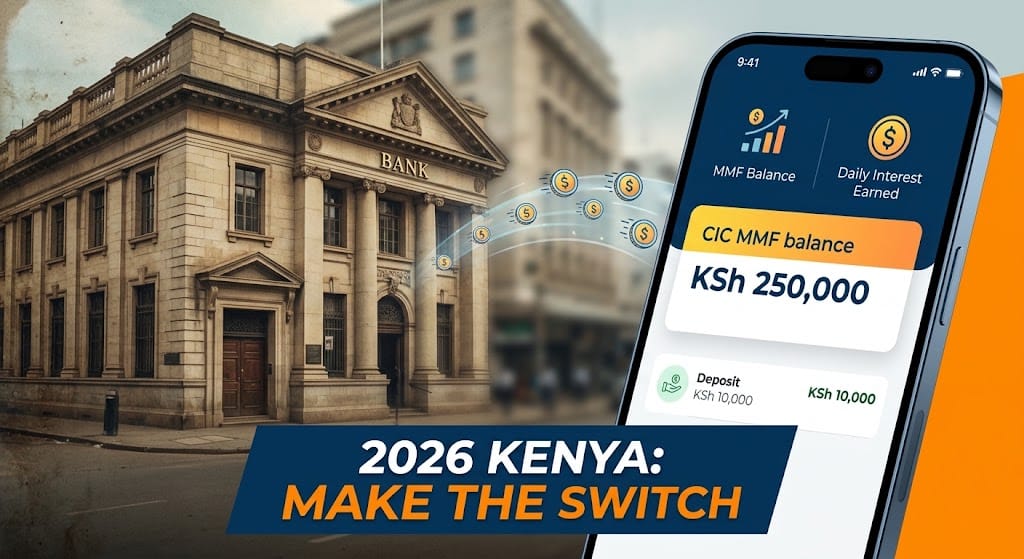
In 2016, a Kenyan bank savings account was a reasonable financial decision.
Interest rates were low across the board, the gap between a savings account and the alternatives was small enough that the convenience of the bank outweighed the difference in returns. Opening a money market fund meant a branch visit, a stack of forms, and several days of waiting. Treasury bills were for institutions and the wealthy. NSE stocks required a stockbroker, a physical account, and a minimum that most salaries could not easily accommodate.
The bank savings account was the default because, for most Kenyans, it was the only practical option.
In 2026, every single one of those justifications has been removed. The friction is gone. The alternatives are accessible from your phone in under 30 minutes. The minimum investment is lower than ever. And the cost of continuing to use the 2016 solution has never been higher.
Most of us are still banking on yesterday. This post is about updating the strategy.
📊 THE NUMBERS: In 2016, the gap between a bank savings account return (5-6%) and a top money market fund (8-9%) was approximately 3 percentage points. In 2026, the gap is 6-10 percentage points, savings accounts at 3-5%, top MMFs at 10-4%. The cost of choosing the savings account has doubled in a decade.
1. What Changed Between 2016 and 2026
The comparison below shows how dramatically Kenya's savings landscape has shifted in ten years — and why the bank savings account, which was once merely suboptimal, has become actively costly.
| 2016 Kenya | 2026 Kenya | The change | |
| Savings account rate | 5-6% | 3-5% | ↓ Lower than before |
| Top MMF rate | 8-9% | 10-14% | ↑ Higher than before |
| Gap (cost of inertia) | ~3 percentage points | 6-10 percentage points | ↑ Gap has doubled |
| Inflation rate | ~5.4% average | 6-9% average | ↑ More persistent |
| MMF minimum deposit | KSh 5,000-10,000 | KSh 100-2,500 | ↓ Almost anyone can invest |
| How to open MMF | Branch visit, 3-5 days | M-Pesa, 20–30 minutes | ↓ Friction nearly gone |
| NSE minimum | KSh 10,000+ | KSh 1,000 (Sasa Invest) | ↓ Accessible to all |
| T-bill minimum | KSh 50,000 (complex) | KSh 50,000 (DhowCSD app) | ↓ Process simplified |
| Real return on savings | Slight negative | Firmly negative (3-6%) | ↓ Worse than 2016 |
Two rows in that table deserve particular attention.
The rate gap has doubled. In 2016, choosing a savings account over an MMF cost you about 3 percentage points of return annually. In 2026, that same choice costs 6-10 percentage points. On KSh 200,000, that is the difference between earning KSh 10,000 per year and earning KSh 28,000 per year from the same money, with the same effort, simply in a different account.
The friction has collapsed. The argument that MMFs were too complicated, too inaccessible, or required too much money is no longer true. CIC, Sanlam, NCBA, and Zimele all open accounts via M-Pesa in under 30 minutes. Kuza MMF accepts KSh 100. Sasa Invest accepts KSh 1,000 for NSE stocks. The minimum barrier is gone. The process barrier is gone. The only thing left is the decision.

⚠️ HEADS UP: This post is not saying bank savings accounts are bad products. They are excellent for: one month of emergency expenses you might need within 24 hours, money needed for a known expense in the next 7 days, and your salary before it gets distributed to investments. For those purposes, they are the right tool. The problem is using them for everything else.
2. What It Is Actually Costing You Right Now
The loss from keeping excess money in a savings account is not dramatic. It does not arrive as a notification. There is no moment where you feel it happening. That is precisely what makes it so costly, it is completely invisible while being completely real.
Here is the calculation on a specific, common Kenyan scenario:
Scenario: KSh 150,000 in a savings account at 4% annual interest, Kenya inflation at 7%
Interest earned in 12 months = KSh 6,000
Purchasing power lost to inflation = KSh 10,500
Net real loss = KSh 4,500
What the same money earns in a 12% MMF = KSh 18,000
Real gain at 12% MMF after 7% inflation = +KSh 7,500
Annual cost of choosing savings over MMF = KSh 12,000
KSh 12,000 per year on KSh 150,000 saved. That is one month of groceries for a Nairobi family. A school fees instalment. A meaningful addition to next month's investment. Lost silently, every year, to the choice of staying in a savings account.
Multiply that across five years and the compound effect becomes genuinely significant. Not because of market risk or bad investment decisions but simply because of inertia with a product that was designed for a different era.

💡 AI PROMPT: "My Kenyan bank savings account is earning [X]% annually. My current balance is KSh [amount]. Kenya's inflation is approximately 7%. Please calculate: my real return after inflation, how much purchasing power I am losing per year and over 5 years, and how much more I would earn if I moved the excess above a 1-month emergency buffer to a money market fund returning 12%. Show me the actual KSh difference."
3. The 2026 Kenyan Savings Ladder - Where Money Actually Belongs
The right savings strategy in 2026 is not about abandoning the bank account. It is about using each tool for what it was designed to do and nothing more.
Rung 1 - Bank savings account (keep)
Purpose: pure liquidity. Money you might need within 24–48 hours. One month of essential expenses like rent, food, transport, utilities. That is its job in 2026. Nothing more.
Rung 2 - Money market fund (move excess savings here)
Purpose: liquid savings that beat inflation. The MMF is the savings account upgrade, same accessibility (withdrawals within 1-3 business days), higher returns (10-14% vs 3-5%), and available from your phone. This is where your emergency buffer beyond one month should live, and where your monthly investment starts.
Best options in 2026: CIC Money Market Fund, Sanlam Money Market Fund, NCBA Money Market Fund. All accessible via M-Pesa paybill. All open in under 30 minutes.
Rung 3 - Treasury bills (for money you won't need for 3-6 months)
Purpose: guaranteed return above inflation, fixed for the life of the bill. The 91-day T-bill at 14-17% is the highest risk-free return available to Kenyan investors. No market risk. Government-backed. Accessible via DhowCSD.ke. Minimum KSh 50,000.
Rung 4 - NSE stocks (for 5+ year money)
Purpose: long-term wealth building above everything else. The highest long-term real return available in Kenya, but with short-term price volatility that makes it unsuitable for money you might need in less than five years. For patient, long-horizon investing only.
Most Kenyans currently have all their money on Rung 1. The question is not whether to move up the ladder. It is how much to move, to where, and in what order.
💡 AI PROMPT: "I currently have my savings split as follows: savings account KSh [amount], M-Pesa Lock KSh [amount], other KSh [amount]. My monthly expenses are KSh [amount] and my salary is KSh [amount]. Using Kenya's 2026 investment landscape MMFs, T-bills, NSE build me a savings ladder showing exactly how much to keep in each rung. Include specific Kenyan platforms for each rung and tell me how to make the transfers."
4. Your Personalised Action Plan - Based on What You Have Right Now
The right move depends on your current balance. Use this table to find your situation:
| Your situation | Keep in savings | Move immediately | Move next |
| Under KSh 30,000 saved | All of it (emergency buffer) | Nothing yet - build to KSh 30K first | Open MMF now, auto-contribute monthly |
| KSh 30,000–49,999 | KSh 20,000–25,000 (1 month expenses) | KSh 5,000–20,000 → MMF via M-Pesa | Build MMF to KSh 50,000 for T-bill access |
| KSh 50,000-199,999 | 1 month expenses only | Excess → MMF immediately via M-Pesa | KSh 50,000 of MMF → T-bill at next auction |
| KSh 200,000+ | 1 month expenses only | Excess split: 60% MMF / 40% T-bills | Any 5-year money → NSE research begins |
The three steps regardless of your balance:
- Open a money market fund account today if you do not have one - CIC via M-Pesa paybill, Sanlam via M-Pesa, or NCBA via the Loop app. The process takes under 30 minutes.
- Calculate your 1-month essential expenses buffer (rent + food + transport + utilities + phone). That amount stays in your savings account. Everything above it moves to the MMF this week.
- Set up a standing M-Pesa transfer on your next salary day - the investment amount leaves for the MMF before you see it in your spending balance. What you never see, you never spend.
5. 'But I've Been with My Bank for Years'
This is the most common reason Kenyans give for not moving their savings. It deserves a direct answer.
Loyalty to a bank is not a financial strategy. Your bank does not give you a better savings rate because you have been a customer for ten years. It gives you the market rate for the account type you hold — and in 2026, that rate does not beat inflation.
Moving savings to a money market fund does not mean closing your bank account. Your salary still arrives in the bank. Your rent still leaves from the bank. Your debit card still works. The only change is that money sitting above your 1-month buffer moves to a place that pays you fairly for holding it.
You are not leaving your bank. You are just stopping the habit of letting it hold money it has not earned the right to hold.
What about safety?
Money market funds in Kenya are regulated by the Capital Markets Authority and invest primarily in government securities and top-tier bank deposits. No CMA-licensed money market fund has ever failed to return investor funds in Kenya's history. Your bank savings account is KDIC-insured up to KSh 500,000, but so is your current account. You are not losing protection by moving excess savings to an MMF; you are gaining returns.
6. The Update - What Doing Nothing Costs by 2031
Let us run the five-year projection for three common Kenyan scenarios savings account versus money market fund, to make the cost of inertia concrete:
Scenario 1: KSh 50,000 saved, KSh 3,000/month additional -Savings: KSh 94,204 (savings) | MMF: KSh 131,647 (MMF at 12%) | Difference: KSh 37,443
Scenario 2: KSh 150,000 saved, KSh 8,000/month additional - Savings: KSh 291,042 (savings) | MMF: KSh 432,640 (MMF at 12%) | Difference: KSh 141,598
Scenario 3: KSh 300,000 saved, KSh 15,000/month additional - Savings: KSh 611,419 (savings) | MMF: KSh 920,147 (MMF at 12%) | Difference: KSh 308,728
In the third scenario a common profile for a Kenyan professional in their early 30s staying in a savings account costs KSh 308,728 over five years. Not from a bad investment. Not from market risk. From choosing the wrong savings vehicle and doing nothing about it.
✅ KEY TAKEAWAY: The savings account is not the enemy. Inertia is. In 2016, the cost of inertia was manageable. In 2026, with the gap between savings account returns and MMF returns at its widest in Kenya's recent history, inertia has become the most expensive financial habit most Kenyans maintain.
Update the Strategy
Banking on yesterday made sense in yesterday's financial landscape. In 2026, with a phone in your pocket and a 30-minute account opening process between you and a 12% return, it no longer does.
The bank account served a generation of Kenyan savers well. It will continue to serve you well as a one-month emergency buffer and a salary landing account. For everything above that, 2026 has better options. They are accessible. They are regulated. And the cost of not using them is now clearly defined.
The update takes 30 minutes. The returns last a lifetime.
How long has your savings been sitting in a bank account? Share in the comments.
📖 RELATED READING: A Penny Saved Is a Penny Lost: Why Your Kenyan Savings Account Is Working Against You - https://www.thenetworthshift.com/2026/08/savings-account-losing-money-kenya.html the full real-return data on what savings accounts cost Kenyans annually, with the inflation maths in detail.
📖 RELATED READING: Money Market Funds in Kenya: The Complete 2026 Guide - the step-by-step guide to opening a money market fund account in under 30 minutes, with a full comparison of providers.
Disclaimer
This article is published by The Net Worth Shift for educational and informational purposes only. Interest rates, MMF returns, inflation figures, and projected portfolio values cited are approximate and based on publicly available data as of mid-2026 because they are subject to change. Projected figures are illustrative calculations, not guarantees of any specific outcome. Money market funds are regulated by the Capital Markets Authority (CMA) and are not KDIC-insured. Nothing in this article constitutes personalised financial advice. Consult a professional licensed by Kenya's Capital Markets Authority (CMA) at cma.or.ke before making significant financial decisions.