Why M-Pesa Lock Is Keeping Your Money Locked Out of Real Returns
learn why M-Pesa Lock loses money to inflation and explore 3 higher-yielding alternatives in Kenya, including MMFs and T-Bills, in 2026.
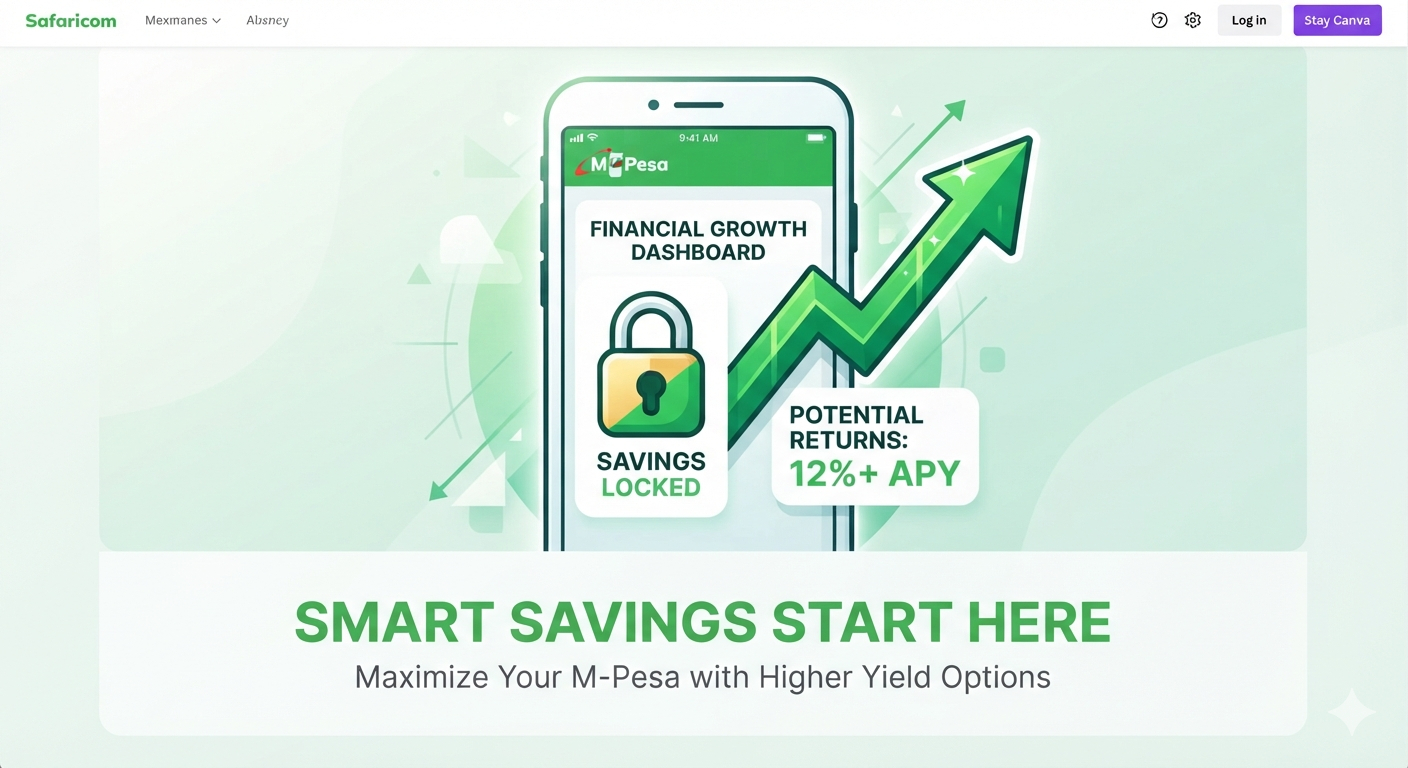
Let me say this clearly before anything else: M-Pesa Lock is brilliant.
It solved a real problem for millions of Kenyans, the problem of saving money and then spending it before the month ends. The friction of locking funds away until a specific date is genuinely effective. People who could never save using sheer willpower found that Lock worked. That is not a small thing.
But here is what Safaricom never advertised alongside the lock icon: M-Pesa Lock is a savings discipline tool, not an investment vehicle. And for the millions of Kenyans using it as their primary savings strategy, it is quietly costing them thousands of shillings every year in returns they never earned.
This post is not telling you to stop using M-Pesa Lock. It is telling you to understand exactly what it is, what it is not, and where your money would work significantly harder once the discipline habit is already formed.
📊 THE MATHS: A Kenyan locking KSh 5,000 per month in M-Pesa Lock at approximately 5% annual return will have approximately KSh 77,000 after 12 months. The same KSh 5,000 per month in a money market fund returning 12% will have approximately KSh 82,500. The difference of KSh 5,500 which is essentially a free month of savings. Every year. Just by changing where the money sits.
1. What M-Pesa Lock Actually Is And What It Was Designed to Do
M-Pesa Lock (now marketed as M-Pesa Go Savings in some versions) is a feature within the M-Pesa ecosystem that lets you set aside money for a fixed period could be a few days, weeks, or months — during which it becomes inaccessible. You choose the amount, choose the date, and the money is locked until that date arrives.
The interest earned on locked funds varies but typically ranges from 4% to 6% annually depending on the lock period and current Safaricom terms. Interest is paid on maturity.
What it was designed for:
- Creating savings friction - making it harder to impulsively spend
- Short-term goal saving - saving for school fees, rent in advance, a specific purchase
- Building the habit of setting money aside regularly
- Accessibility - working entirely within the M-Pesa app millions already use daily
What it was NOT designed for:
- Beating inflation - the return does not consistently outpace Kenya's inflation rate
- Long-term wealth building - the compounding effect at 4-6% is weak over time
- Replacing a proper investment account - it is a product feature, not a regulated investment fund
- Growing your money meaningfully - it protects your money from yourself, not from inflation
The confusion and the cost happens when Kenyans who successfully built the saving habit with M-Pesa Lock never graduate to using that discipline in a better vehicle.
✅ KEY TAKEAWAY: M-Pesa Lock is excellent at one thing: stopping you from spending money you intended to save. Once you have that habit, the next step is finding a home for those savings that actually grows them.
2. The Head-to-Head: M-Pesa Lock vs Your Real Alternatives
Let us put M-Pesa Lock side by side with the two most comparable alternatives for Kenyan savers — money market funds and treasury bills. All figures are approximate and based on mid-2026 rates.
| Feature | M-Pesa Lock | Money Market Fund | T-Bill (91-day) |
| Annual return (approx.) | 4-6% | 10-14% | 14-17% |
| Minimum amount | KSh 1 | KSh 100–2,500 | KSh 50,000 |
| Access to money | Locked until date | 1-3 business days | At maturity (91 days) |
| Regulated by | CBK / Safaricom | Capital Markets Authority | Central Bank of Kenya |
| Risk level | Very low | Very low | Essentially zero |
| KDIC insured? | No | No | Government-backed |
| M-Pesa deposit? | Yes - native | Yes - most providers | No - bank transfer |
| Real return (7% inflation) | Negative 1-3% | Positive 3-7% | Positive 7-10% |
| Best used for | Impulse control habit | Emergency fund + savings | Medium-term savings |
Three numbers in that table deserve specific attention.
First, real return. At Kenya's current inflation rate of approximately 6-9%, M-Pesa Lock's 4-6% return is negative in real terms. Your money grows in nominal value but shrinks in purchasing power. We covered this in detail in: A Penny Saved Is a Penny Lost.
Second, access to money. M-Pesa Lock is genuinely locked until the date you choose. A money market fund gives you access within 1-3 business days with no penalty, no waiting for a specific date. This makes the MMF strictly better for emergency funds.
Third, minimum amount. A money market fund accepts as little as KSh 100 with Kuza and KSh 1,000 with most major providers. The M-Pesa Lock advantage of starting from KSh 1 no longer differentiates it meaningfully.
⚠️ HEADS UP: M-Pesa Lock rates are set by Safaricom and can change without much notice. Always check the current rate in your M-Pesa app before deciding how long to lock funds because the advertised rate sometimes differs from what is actually paid at maturity. Screenshot the rate confirmation when you lock funds so you have a record.
3. The Real Cost - What M-Pesa Lock Is Costing You Over Time
The difference between 5% and 12% sounds abstract until you run the numbers over real timelines. Here is what the gap actually looks like for a Kenyan saver putting aside KSh 5,000 per month consistently:
KSh 5,000/month - M-Pesa Lock at 5% vs Money Market Fund at 12%
1 year: Lock → KSh 61,335 | MMF → KSh 63,594 | Difference: KSh 2,259
2 years: Lock → KSh 125,786 | MMF → KSh 134,744 | Difference: KSh 8,958
3 years: Lock → KSh 193,532 | MMF → KSh 214,999 | Difference: KSh 21,467
5 years: Lock → KSh 340,122 | MMF → KSh 407,948 | Difference: KSh 67,826
10 years: Lock → KSh 775,680 | MMF → KSh 1,166,892 | Difference: KSh 391,212
Over ten years, the gap becomes KSh 391,212 from putting aside the same amount every month. That is nearly four years of savings contributions entirely accounted for by the difference in return. Not by working harder. Not by earning more. Simply by choosing a better vehicle for the same discipline.
💡 AI TIP: Paste this into ChatGPT to calculate your personal numbers: 'I save KSh [your monthly amount] every month. Compare what I would have after 1, 3, 5, and 10 years if my money earns 5% annually versus 12% annually. Show me the total amount saved, the interest earned in each case, and the difference between them. I am in Kenya and these are the rates for M-Pesa Lock vs a money market fund.'
4. 'But I Need the Lock - I'll Spend It Otherwise'
This is the most honest objection and it is a good one. The whole point of M-Pesa Lock for many people is precisely that they cannot access it. Remove the lock and they will spend it.
If that is genuinely you, here is the key insight: money market funds have a natural friction too. They are not instant. To access your money, you submit a withdrawal request and wait 1-3 business days. That gap between deciding to withdraw and actually having the cash is often enough time to reconsider an impulse purchase.
But if you know yourself well enough to know that even 48 hours of access would be too tempting, here is a better system than M-Pesa Lock:
- Open a money market fund account keep this completely separate from your M-Pesa and your bank account mentally. It is your investment account, not a spending account.
- Set up an automatic transfer on salary day, the money leaves your M-Pesa immediately and goes straight to the MMF. You never see it in your spending balance.
- Remove the MMF app from your phone's home screen because out of sight, out of mind. The money grows without you being tempted to check it daily.
- Keep a small amount, perhaps one month of expenses in M-Pesa Lock if you genuinely need that hard stop. But only one month, not all of your savings.
The discipline habit M-Pesa Lock built in you is genuinely valuable. That habit does not require M-Pesa Lock to survive it just needs a new home.
5. How to Migrate Your M-Pesa Lock Savings - Step by Step

Here is exactly what to do, based on how much you currently have locked:
| Your M-Pesa Lock balance | Recommended move | Where to go | Time to set up |
| Under KSh 1,000 | Keep in Lock for now — too small to transfer efficiently | Build to KSh 1,000 then move | N/A |
| KSh 1,000-49,999 | Move to money market fund | CIC, Sanlam, NCBA, or Zimele via M-Pesa | 20-30 minutes |
| KSh 50,000+ | Split: MMF for emergency buffer + T-bills for rest | MMF via M-Pesa + DhowCSD for T-bills | MMF: 20 min · T-bills: 1–2 days |
| Any amount - ongoing | Stop locking new savings in Lock; auto-transfer to MMF | Set up M-Pesa standing order to MMF paybill | 5 minutes |
The practical steps for the most common situation - KSh 1,000 to KSh 49,999:
- Wait for your current M-Pesa Lock to mature - do not break it early if there is a penalty
- When it matures and the funds return to your M-Pesa, do not re-lock them
- Open a money market fund account if you have not already consider CIC Money Market Fund is the most straightforward via M-Pesa
- Transfer the unlocked funds directly to your MMF via M-Pesa Lipa na M-Pesa →Pay Bill using the MMF's paybill number
- Set up a standing order or recurring contribution to the MMF on your next salary day
- Do not look at the balance for 30 days rather let it grow undisturbed
💡 AI TIP: Use this prompt to plan your migration: 'I currently have KSh [amount] in M-Pesa Lock earning approximately 5% annually. I want to move this to a money market fund. Help me: choose between CIC, Sanlam, and NCBA money market funds for a Kenyan beginner, tell me exactly how to transfer money from M-Pesa to each fund, and show me how much more I will earn over the next 12 months by making this switch.'
6. When M-Pesa Lock Still Makes Sense
In the spirit of fairness, because this post is about making good decisions, not vilifying a product — here are the situations where M-Pesa Lock is actually the right tool:
- You are saving for something in the next 30-90 days and need the money to stay completely untouched
- You are new to saving and the hard lock is the only thing standing between you and spending it and the habit is worth more than the return difference at this stage
- The amount is under KSh 5,000 and the administrative overhead of opening an MMF account outweighs the return difference right now
You are saving for a very specific purpose with a very specific date, school fees due in 6 weeks, for example and you want certainty about access timing
In all other situations, ongoing savings, emergency fund building, any horizon longer than 90 days, any amount over KSh 5,000 in a money market fund or treasury bill is the better vehicle. Same discipline, better return, same Kenyan ecosystem.
The Unlock
M-Pesa Lock gave millions of Kenyans something genuinely valuable: proof that they could save. That confidence knowing you are a person who saves is worth something real and significant.
But the lock was always supposed to be a starting point, not a destination. The destination is a portfolio that beats inflation, grows with compounding, and actually shifts your net worth in the direction it should be going.
Unlock your savings. Put them somewhere that works as hard as you do.
Know someone still using M-Pesa Lock for all their savings? Share this with them.
📖 RELATED READING: A Penny Saved Is a Penny Lost: Why Your Kenyan Savings Account Is Working Against You read the full story on why savings accounts and M-Pesa Lock both lose to inflation, and where to move your money instead.
📖 RELATED READING: Money Market Funds in Kenya: The Complete 2026 Guide, the step-by-step guide to opening a money market fund account, with a full comparison of CIC, Sanlam, NCBA, and five other Kenyan providers.
Disclaimer
This article is published by The Net Worth Shift for educational and informational purposes only and does not constitute personalised financial advice. M-Pesa Lock rates, money market fund returns, and treasury bill yields cited are approximate figures based on publicly available information as of mid-2026 and are subject to change. M-Pesa is a registered trademark of Safaricom PLC, this post is not affiliated with or endorsed by Safaricom. Investment involves risk. Money market funds are regulated by the Capital Markets Authority (CMA) but are not KDIC-insured. Verify current rates directly with providers before making financial decisions. Consult a CMA-licensed professional at cma.or.ke.