The Complete Guide to Investing in Kenya for Beginners (2026)
New to investing in Kenya? This complete 2026 guide covers money market funds, T-bills, and NSE stocks plus how free AI tools can build your plan fr

Let me tell you something nobody told me at my first job. I was earning a decent salary, putting money in a savings account every month, watching the number grow and feeling responsible about it. What I didn't know was that every month, inflation was quietly eating away at the real value of that money. I wasn't building wealth. I was losing it slowly, with a smile on my face. The average Kenyan bank savings account pays 3-5% interest. Kenya's inflation has averaged 6-9% annually over the past decade. Do that maths. You are moving backwards while standing still. The good news: investing in Kenya in 2025 is more accessible than it has ever been. You can start with as little as KSh 100. You do not need a stockbroker, a financial advisor or any prior experience. You just need the right information and that is exactly what this guide is.
✅ KEY TAKEAWAY: By the end of this guide you will know the four best investment options for Kenyan beginners, exactly how much to put in each, and how to use a free AI tool to build your own personalised investment plan in under 10 minutes.
What we cover in this guide
- Why your savings account is working against you
- The 4 best investment options for Kenyan beginners
- How to build your investment plan with free AI tools
- The 50-30-20 rule adapted for Kenyan salaries
- The 5 mistakes that cost Kenyan’s money every year
- Your first-week action plan step by step
1. Why Your Savings Account Is Working Against You
Here is a number that should concern every Kenyan with a bank account: the real return on your savings. Real return = interest rate minus inflation rate. If your bank pays you 4% annually and inflation runs at 7%, your real return is negative 3%. You earned money on paper. You lost purchasing power in reality. The KSh 100,000 you saved this year will only buy what KSh 97,000 buys today and next year, it gets worse.
📊 BY THE NUMBERS: KSh 100,000 in a savings account at 4% interest = KSh 104,000 after one year. But if inflation is 7%, the same basket of goods that cost KSh 100,000 now costs KSh 107,000. Net result: you are KSh 3,000 poorer in real terms, not richer.
This does not mean savings accounts are useless. They serve a purpose primarily as your emergency fund, the money you need to access quickly without warning. Three to six months of expenses in an accessible account is essential financial security. The problem is when your savings account becomes your entire financial strategy. When every extra shilling after rent, food, and transport sits earning 4% while inflation runs at twice that you are paying a silent, invisible tax on your own hard work. The solution is not to stop saving. It is to put the money you do not need immediately into investment vehicles that outpace inflation. In Kenya in 2025, several of these options are available to ordinary people on ordinary salaries, and they are more accessible than most Kenyans realise.
2. The 4 Best Investment Options for Beginners in Kenya
Before we go into detail: everything in this section is for educational purposes. I am not a licensed financial advisor and this is not investment advice. Always do your own research and consult a professional licensed by Kenya's Capital Markets Authority (CMA) before making decisions. You can verify licensed firms at cma.or.ke. With that clear, here are the four investment options I believe every Kenyan beginner should understand, starting from the lowest risk.
Option 1: Money Market Funds - Start Here
A money market fund (MMF) is a pool of money from thousands of investors, placed into low-risk short-term instruments primarily government securities and bank deposits. You earn interest daily on whatever you have invested, and you can withdraw within 1–3 business days. In 2025, the top Kenyan money market funds are returning between 10% and 14% annually. That is two to three times what most bank savings accounts offer, with comparable safety and much better liquidity than locking your money into a fixed deposit.
Why MMFs are the ideal starting point:
- You can start with as little as KSh 1,000 with most providers
- Your money earns interest daily - not just at month-end
- Withdrawals are fast - 1 to 3 business days in most cases
- Regulated by the Capital Markets Authority
- Lower risk than stocks or bonds
The leading money market funds in Kenya in 2025:
- CIC Money Market Fund - consistently strong returns, accessible via M-Pesa
- Sanlam Money Market Fund - competitive rates, good mobile app experience
- NCBA Money Market Fund - seamlessly integrated with NCBA Loop banking
- Zimele Unit Trust - suitable for Safaricom/M-Pesa ecosystem users
- Madison Asset Money Market Fund - solid track record, lower minimum
💡 AI TIP: Ask ChatGPT (free): 'What are the current top money market fund returns in Kenya? Compare CIC, Sanlam, NCBA, and Zimele by annual return, minimum investment, and withdrawal time.' Use this to update your comparison every quarter as rates shift.
For a full comparison of Kenyan money market funds including step-by-step account opening instructions, see our dedicated guide: Money Market Funds in Kenya - Full Comparison & Guide.
Option 2: Treasury Bills and Bonds - Risk-Free at Remarkable Rates
Treasury bills (T-bills) and government bonds are Kenya's safest investment vehicle. When you buy one, you are lending money to the Government of Kenya and they pay you back with interest. The government has never defaulted on its domestic debt obligations, making these as close to risk-free as any investment in Kenya gets. What makes this especially compelling in 2025 is the rate environment. Kenya's 91-day T-bill rates have been consistently yielding between 14% and 17% annually, rates that most bank fixed deposits cannot come close to matching.
📈 CURRENT RATES (approximate, 2025): 91-day T-bill: 14–17% annually | 182-day T-bill: 15–17% annually | 364-day T-bill: 15–17% annually | Infrastructure bonds: 13–16% (tax-free). Check the latest weekly results at the Central Bank of Kenya website: centralbank.go.ke
How to buy treasury bills in Kenya:
- Go to dhowcsd.ke - the Central Bank of Kenya's investor portal
- Register and create your account (requires your ID, KRA PIN, and bank account details)
- Wait for the next weekly auction - T-bill auctions are held every Monday
- Submit a bid - you can choose competitive or non-competitive bidding
- Fund your account and collect your returns at maturity
The minimum investment for treasury bills is KSh 50,000. If you are not yet at that amount, focus on building your money market fund first, then move into T-bills once you reach the threshold.
💡 AI TIP: Paste this into ChatGPT: 'Walk me through opening a DhowCSD account in Kenya step by step. What documents do I need? How does the bidding process work for a first-time investor?' It will walk you through the entire process in detail.
Option 3: NSE Stocks - Best for Long-Term Wealth
The Nairobi Securities Exchange (NSE) is Kenya's stock market where you can buy small ownership stakes in companies like Safaricom, Equity Bank, KCB Group, EABL, and dozens of others. When those companies grow and profit, the value of your stake grows too. Many also pay dividends which is a regular share of profits distributed to shareholders. NSE investing is best suited for money you will not need for at least three to five years. Stock prices move up and down daily, and short-term volatility is completely normal. Investors who hold quality stocks over long periods have historically seen significantly better returns than any fixed-income instrument.
How to start investing in NSE stocks:
- Sasa Invest (sasa.co.ke) - best mobile-first platform for beginners, minimum KSh 1,000
- Genghis Capital - established stockbroker, suited for larger portfolios
- Standard Investment Bank - strong research support for serious investors
- EFG Hermes - good for investors wanting regional African exposure
⚠️ IMPORTANT: Companies mentioned here are examples for educational purposes only. They are not recommendations to buy or sell any specific stock. Stock investing carries the risk of losing your invested capital. Past performance does not guarantee future returns. Research any company thoroughly and consult a CMA-licensed advisor before investing.
💡 AI TIP: Copy this prompt into ChatGPT: 'I want to start investing in the Nairobi Securities Exchange as a beginner in Kenya. Explain: what is a dividend? What is a P/E ratio? How do I evaluate whether a stock is fairly priced? What documents do I need to open a CDS account?' Use it as your personal stock market tutor.
Option 4: SACCOs - Community Wealth, Accessible Credit
A SACCO (Savings and Credit Cooperative Organisation) is a member-owned financial institution where members pool resources, earn competitive returns on savings, and access loans at significantly lower rates than commercial banks. Kenya has one of the most developed SACCO sectors in Africa, with over 10,000 registered SACCOs and a combined asset base in the trillions of shillings. For Kenyans who want both a saving vehicle and access to affordable credit for property, education, or business a SACCO is often the most powerful tool available.
What makes SACCOs compelling:
- Dividends typically range from 8–15% annually on member deposits
- Loan interest rates: typically, 1% per month on reducing balance, far cheaper than bank loans
- Long membership history builds eligibility for larger loans
- Many offer FOSA (Front Office Service Activities) - basic banking services
Well-known SACCOs in Kenya:
- Mwalimu National SACCO - for teachers and education sector
- Stima SACCO - for energy, utilities, and related sectors
- Harambee SACCO - for civil servants
- Kenya Police SACCO - for security services
- Fortune SACCO - open membership, suitable for private sector workers
Most employer-based SACCOs accept members from related industries. If you work in the private sector without a specific employer SACCO, look for open-membership SACCOs or check SASRA (Sacco Societies Regulatory Authority) at sasra.go.ke for a full list of licensed SACCOs.
3. How to Build Your Investment Plan Using Free AI Tools
Here is where most personal finance content stops being useful, it tells you what exists but not how to personalise it to your actual life. That gap is exactly where free AI tools like ChatGPT become genuinely powerful. You do not need to pay a financial advisor to get a tailored starting point for your investment plan. A well-prompted AI tool can help you build one in under 10 minutes for free. Here is how.
Step 1: Open ChatGPT
Go to chat.openai.com and sign in or create a free account. The free version (GPT-3.5 or GPT-4o depending on availability) is fully sufficient for this exercise.
Step 2:Use this exact prompt
Copy and paste this replace the brackets with your real numbers:
"I live in Kenya. My monthly take-home salary is [your amount]. My monthly expenses total approximately [your amount]. I currently have [your savings amount] saved. I want to start investing for the first time. Please create a simple, realistic, and personalised investment allocation plan using only investment options available in Kenya in 2025. Include: specific fund names, platforms I can use to invest, how much I should put in each option monthly, and what I should prioritise first. Keep the language simple. I am a beginner."
Step 3: Ask follow-up questions
Once you have your initial plan, go deeper with follow-ups:
- "How do I open a money market fund account via M-Pesa? Give me step-by-step instructions."
- "What documents do I need to open a DhowCSD account for treasury bills in Kenya?"
- "Explain what a SACCO is and how I find one that is open to private sector workers in Nairobi."
- "What is the tax treatment of dividend income and bond interest in Kenya?"
- "In 5 years, if I invest KSh 10,000 per month with a 12% annual return, what will I have?"
⚠️ IMPORTANT: AI tools including ChatGPT can produce outdated or inaccurate information. Always verify specific rates, platform details, and regulatory requirements directly with the provider or regulator before investing any money. Use AI as a starting point for research — never as your final authority on financial decisions.
For a complete guide to using free AI tools for personal finance beyond ChatGPT, including tools for budgeting, expense tracking, and portfolio monitoring read: How to Use AI for Personal Finance: The Ultimate Beginner Guide.
4. How Much Should You Invest? The 50-30-20 Rule for Kenya

The most common question beginners ask is how much of their salary they should invest. A useful starting framework is the 50-30-20 rule is a widely used personal finance guideline adapted here for Kenyan realities.
50% - Needs: rent, food, transport, utilities, school fees, medical
30% - Wants: eating out, entertainment, subscriptions, shopping
20% - Wealth building: investing, saving, debt repayment
On a salary of KSh 60,000 near the median formal sector salary in Nairobi the 20% wealth-building allocation comes to KSh 12,000 per month. Here is how you might allocate that across the four options we covered:
- KSh 5,000 → Money market fund (emergency fund, building toward KSh 50K for T-bills)
- KSh 3,000 → Treasury bills via DhowCSD (once you reach the KSh 50,000 minimum)
- KSh 2,500 → NSE stocks via Sasa Invest (long-term wealth building, minimum KSh 1,000)
- KSh 1,500 → SACCO contributions (community wealth and future loan eligibility)
📌 IMPORTANT NOTE: This is an illustrative example is not a recommendation. Your actual allocation depends entirely on your income, expenses, existing debts, family obligations and financial goals. A person with high-interest debt (e.g. mobile loans at 20%+) should prioritise clearing that debt before investing because, no investment return currently beats the cost of expensive debt.
If KSh 12,000 feels unreachable right now, start with what you can. KSh 1,000 in a money market fund is not just a small start, it is proof to yourself that you are the kind of person who invests. The habit matters far more than the amount in the early months.
5. The 5 Mistakes That Cost Kenyans Money Every Year
These are not hypothetical mistakes. They are the ones I made, that people around me have made, and that show up consistently in personal finance conversations across Kenya. Learning them now costs you nothing. Discovering them later can cost you years.
Mistake 1: Using M-Pesa Lock as Your Investment Strategy
M-Pesa Lock (now called M-Pesa Go) has a place in your financial life — it adds a useful friction that stops impulse spending. But the returns it offers are modest compared to a money market fund. Many Kenyans treat it as an investment vehicle when it is really a savings discipline tool.
Fix: Move your locked funds into a money market fund once you have accumulated more than KSh 5,000. You keep the discipline of not touching it, but earn 2–3× more interest. The same psychology, a much better return.
Mistake 2: Waiting Until You Have 'Enough' to Start
There is no amount that makes you ready to begin. The belief that you will start investing when your salary reaches a certain number is one of the most expensive financial myths in Kenya. Compounding is the process of earning returns on your returns and requires time above all else. A KSh 1,000 investment made today is worth more than a KSh 10,000 investment made five years from now, all else equal.
Fix: Start with whatever you have. Open a money market fund account this week, even if your first deposit is KSh 1,000. The account being open and active is worth more than a perfect plan you have not acted on.
Mistake 3: Putting Everything in One Place
Concentration risk - having all your money in one investment type which means one bad outcome can damage your entire financial position. This is not just a risk for stock investors. It applies to anyone who puts everything in a single SACCO, a single money market fund, or only treasury bills.
Fix: Spread your investment allocation across at least two different instrument types. The four options in Section 2 are designed to complement each other, low-risk MMFs as your base, higher-return T-bills for medium-term growth, NSE stocks for long-term wealth, and a SACCO for community access and credit.
Mistake 4: Chasing Extremely High Returns
If an investment opportunity promises you returns of 30%, 50%, or higher in a month, not a year, treat it as a red flag, not an opportunity. Kenya has seen numerous high-profile investment fraud cases that wiped out the savings of thousands of people who were promised extraordinary returns.
Fix: Benchmark against legitimate instruments. Treasury bills yielding 15–17% annually are exceptional by global standards. Any opportunity claiming to significantly beat that with low or no risk warrants extreme skepticism. Check whether any investment firm you use is licensed at cma.or.ke.
Mistake 5: Ignoring Tax Implications
Investment returns in Kenya are subject to taxation. Withholding tax is applied to money market fund distributions, stock dividends, and bond interest at varying rates. Most investors do not think about this until it reduces their actual payout and then feel cheated by an outcome they could have anticipated. Fix: Ask your fund manager or broker specifically how distributions are taxed and what you will actually receive after tax. Infrastructure bonds are a useful note here, their interest is tax-exempt, which meaningfully improves the real return compared to a headline rate comparison would suggest.
💡 AI TIP: Ask ChatGPT: 'Explain the withholding tax rates on investment income in Kenya for money market funds, NSE dividends, treasury bills, and bonds. Which investments have better after-tax returns?' This gives you a personalised tax primer in under 2 minutes.
6. Your First-Week Action Plan
Every piece of financial content you read and do nothing with costs your future wealth. Here is a concrete seven-day plan to go from reading this guide to having your first investment account active and funded.
Day 1: Know your numbers. Write down your monthly take-home salary, your fixed monthly expenses and what is left over. This is your investable surplus the number everything else is built on.
Day 2: Open ChatGPT and use the prompt from Section 3 to generate your personalised allocation plan. Save or screenshot the output.
Day 3: Research the top two money market funds for your situation. Go to the official websites of CIC Asset Management and Sanlam Kenya. Compare returns, minimums, and withdrawal terms.
Day 4: Open a money market fund account. Most providers allow online registration in 15–30 minutes. Make your first deposit via M-Pesa, even KSh 1,000 before you close the tab.
Day 5: Register at dhowcsd.ke. Complete the CDS account registration even if you are not ready to buy yet. Having the account open puts you one click away from your first T-bill auction.
Day 6: Download the Sasa Invest app. Browse the stocks. Read about two or three companies. Do not buy anything yet just familiarise yourself with how it works and what the numbers mean.
Day 7: Set up automation. Create a standing order on your banking app to transfer your investment amount to your money market fund on the same day your salary arrives each month. Remove the decision. Automation is the single most powerful financial habit you can build.
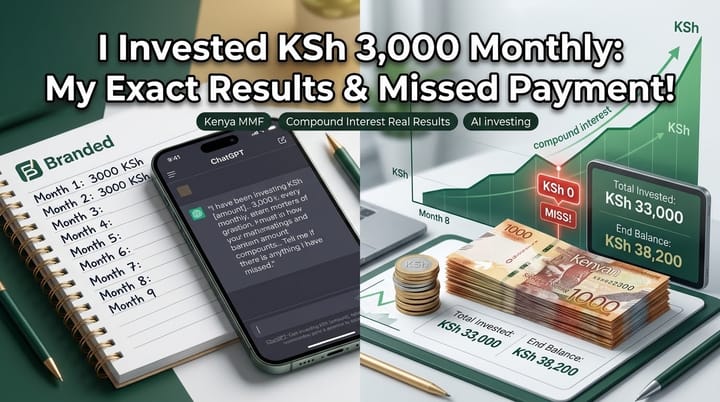
✅ KEY TAKEAWAY: The person who invests KSh 3,000 per month automatically for 10 years almost always outperforms the person who plans to invest KSh 10,000 per month manually because consistency compounds, and willpower does not.
The Bottom Line Investing in Kenya in 2026 is not complicated, exclusive or reserved for people who already have money. It is accessible, increasingly digital, and capable of transforming the financial trajectory of any Kenyan who begins regardless of starting salary. The gap between people who build wealth and people who struggle financially is almost never income. It is almost always what they did with that income, consistently, over time. You now have the roadmap, the tools, and the first-week plan. The only variable left is whether you act on it.
📖 WHAT TO READ NEXT: Money Market Funds in Kenya: Full Comparison & Guide. A deep dive into every major Kenyan MMF with current rates, minimum investment amounts, and step-by-step account opening instructions for each one.
Disclaimer This article is published by TheNetWorthShift for educational and informational purposes only. Wakarindi Macharia is not a licensed financial advisor, investment broker, or regulated financial professional in Kenya or any other jurisdiction. Nothing in this article constitutes personalised financial, investment, tax, or legal advice. Investment products mentioned including money market funds, treasury bills, NSE stocks, and SACCOs involve risk, including the possible loss of principal. Past performance does not guarantee future results. Interest rates and fund returns cited are approximate and subject to change. Always conduct your own research and consult a professional licensed by Kenya's Capital Markets Authority (CMA) before making any investment decision. For a list of licensed investment firms, visit cma.or.ke.